Choosing a Keepsake Piece for a Grandfather
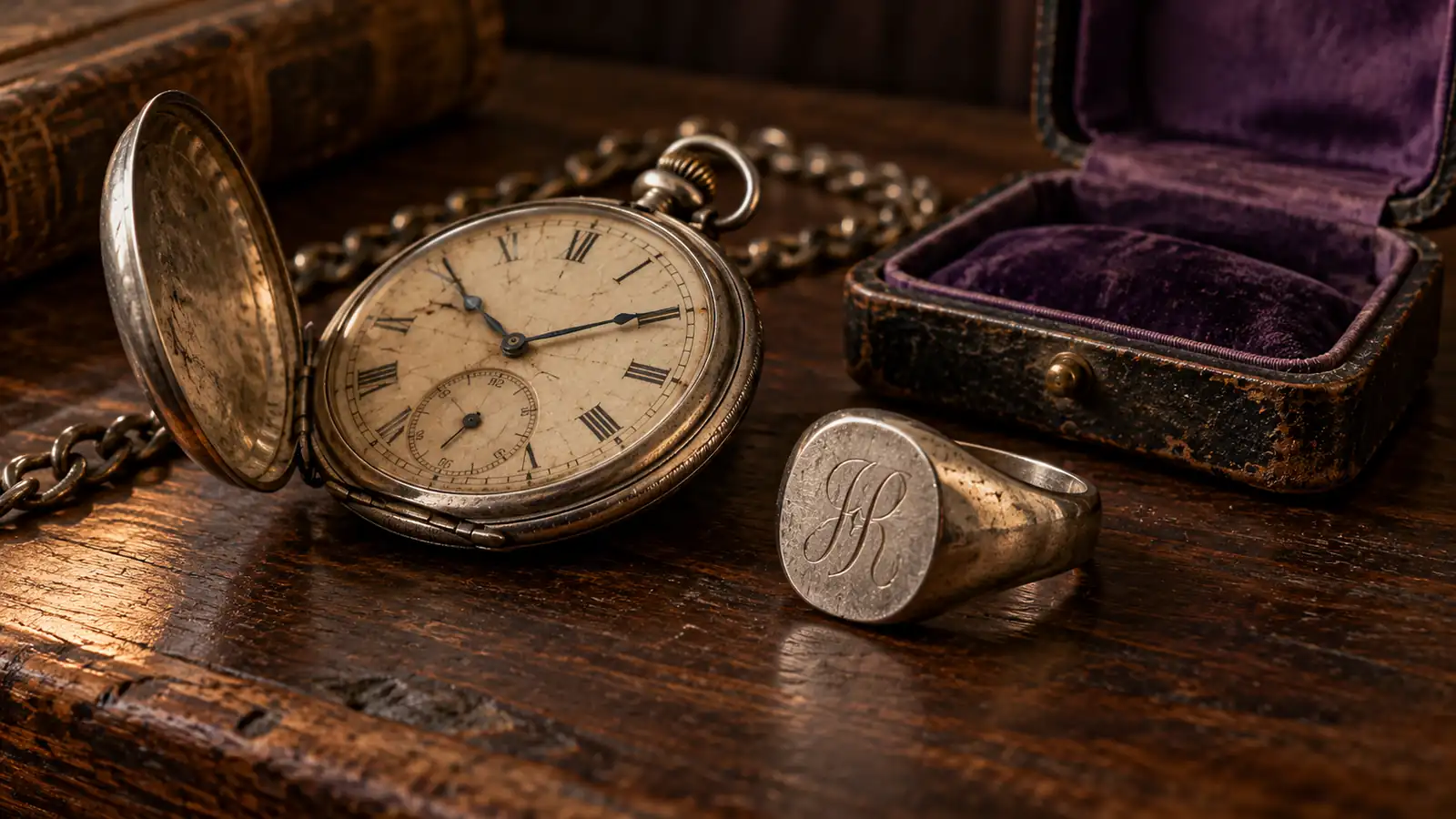
Of all the people on a gift list, a grandfather is usually the hardest. He has everything he needs, wants very little, and has probably worn the same wedding ring and the same watch for forty years. Which is exactly why a keepsake can work: not a fashion item, but one object with a name and a date on it that outlasts the occasion. This guide covers what gets worn rather than put away, how signet rings and engraving actually work, how to size a ring without asking him to try one on, and what to give instead if a ring is the wrong answer.
What an older man will actually wear
Men who wear jewellery at all tend to wear very little of it, constantly: a wedding ring, a watch, perhaps a signet ring on the little finger. Men who wear none are unlikely to start at eighty. The useful distinction is between jewellery he must put on and jewellery that simply stays on, and the successful gifts are all in the second category.
What works, broadly:
- A signet ring — the traditional British men's ring, and the one most likely to be worn without comment, because it is a recognised form rather than an ornament.
- A plain, substantial band — unobtrusive, and easy to engrave inside where only he sees it.
- Cufflinks — only if he still wears shirts that take them. Check the cuffs before buying; this is the most commonly misjudged men's gift there is.
- A tie pin or collar bar — charming and genuinely used by some older men, entirely unused by others.
- A keepsake that is not worn at all — an engraved hip flask, a card case, a hallmarked keyring. These sidestep every fitting problem and are often the better answer for a man who does not wear jewellery.
What rarely works: bracelets, visible neck chains, anything with a stone on display, anything that announces itself. Not because he would dislike it, but because settled habits are a lot to ask a present to change.
The signet ring, and family continuity
The signet is the one men's ring with real history behind it, and the one most often given as a keepsake.
Originally it was a working object: the flat or domed face was engraved in reverse, cut into the metal rather than onto it, so that pressing it into hot wax left a raised impression the right way round. That cutting is called seal engraving, or intaglio, and it is a specialist craft. Most signet rings today are cut the other way, as the design reads — surface engraving — which looks correct but will not seal. If sealing matters, say so when you order: it is a different job and takes longer.
In Britain a signet is conventionally worn on the little finger of the left hand, though that is custom rather than rule. The little finger matters practically: it is the smallest size on the hand, and the one most people have never had measured.
On what goes on the face there is one point of genuine substance. A crest or coat of arms is not a surname badge that anyone of that name may use. In England, Wales and Northern Ireland the right to bear arms is a matter for the College of Arms; in Scotland the Court of the Lord Lyon regulates it, and unauthorised use there is a legal matter rather than a point of etiquette. Many "family crest" designs offered for engraving belong to someone else entirely. If your family has arms, the relevant authority can confirm what you are entitled to; if it does not, and most do not, initials are both correct and more personal — which is what most British signet rings carry anyway.
The signet also works unusually well as a continuity gift: the same form given to a grandfather, a father and a son, each with his own initials, reads as a family habit rather than three separate presents.
Engraving: what is legible, and what is wishful
- Two or three initials on a signet face is the classic and stays readable for a lifetime. Interlaced or block both work; interlaced hides wear better.
- A date fits alongside or inside. Write the month in letters — a numeric date reads differently on either side of the Atlantic, and a keepsake should not be ambiguous in fifty years.
- A short phrase belongs inside a band, not on a face, and the narrower the band the fewer words you get.
- Hand engraving is cut deeper than machine engraving and survives decades of wear against skin far better. For something meant to be inherited, ask for hand work.
- Larger, simpler letter forms last longer. Fine script on a small face is beautiful on day one and indistinct after twenty years of handshakes.
Two practical warnings. Engraving takes time — days, and considerably more in December. And personalised goods are normally excluded from the statutory right to cancel an order placed at a distance, so the sequence must be: confirm the size, then engrave. Never the other way round.
Sizing a ring when he cannot try it on
The best approach is to borrow a ring he already wears on the finger you are buying for and take it to a jeweller, who will read it on a tapered steel mandrel in a couple of minutes. The caution is that this must be the right finger: a wedding ring from the third finger tells you nothing useful about the little finger, which is typically several sizes smaller. If the only ring available is from the wrong finger, it is not a measurement.
If no ring is available, measure the finger directly. Cut a strip of ordinary paper about five millimetres wide, wrap it round the base of the finger, snug without biting, then work it back over the knuckle while it is still wrapped — a ring has to clear the knuckle before it can sit at the base. Mark the overlap, measure the length flat against a rule, and give that figure to a jeweller to convert. Do not use string, which tightens unevenly and reads small.
A few points specific to this situation:
- Measure at the end of a normal day, at room temperature. Hands are fuller when warm and slimmer when cold, and the difference can be half a size or more.
- British sizes are letters, running through the alphabet with a half size between each pair, and the scale continues past Z. A shop's stock range is not the limit of the scale: a measurement outside it is a made-to-order job, not an error.
- A wide or heavy signet fits more tightly than a fine band of the same size. Allow roughly half a size for anything substantial.
- Buy a shape that can be altered. A plain signet with an uninterrupted shank resizes easily; patterned shoulders or engraving running round the band do not.
- If the knuckle is noticeably wider than the base, ask about sizing beads or a sprung insert inside the band, so the ring passes the knuckle and is held still at the base.
Where the fit is genuinely uncertain, give the ring unengraved with a note that the engraving is to come. It keeps your options open and makes the present a two-part event rather than a gamble.
Metal and care, when handling a cloth is a nuisance
Choose a metal that looks after itself, because the maintenance will not get done.
Sterling silver is 925 parts silver per thousand and will tarnish in time, as sulphur compounds in the air react with the surface. That darkening is a surface change, not damage, and on a signet it is not necessarily unwelcome: tarnish settles into engraved lines and makes them more legible, which is why some engraved silver is deliberately oxidised. A ring worn daily largely polishes itself against skin and cloth.
Where upkeep is a real concern, the easier choices are a higher-wearing metal such as gold or platinum, or silver with protective rhodium plating, which resists tarnish for a long period and can be renewed by a jeweller. For a piece that sits unworn between occasions, an airtight bag with an anti-tarnish strip does more good than any amount of polishing and asks nothing of him.
Avoid giving cleaning jobs as part of the gift: a soft cloth in the box is thoughtful, a kit of liquids and brushes is a chore. One warning worth passing on — abrasive pastes, and home remedies involving foil and hot solutions, remove surface metal and take the crispness out of engraving. If a keepsake needs real attention, it is a jeweller's job.
Passing it on
The simplest thing you can do is write down what it is: who gave it, when, what the initials stand for, and which assay office mark it carries if it is fully hallmarked. One index card kept with the piece preserves the story; without it a ring is anonymous within two generations.
Where there is an intention about who inherits a piece, it belongs in a will or a written note alongside one, not in a remembered conversation — jewellery is argued over precisely because the intentions were verbal. And a ring sized for one person can usually be altered for another, so an inherited signet is not stuck with the hand it came from.
If a ring is the wrong answer
It often is, and that is fine: the keepsake quality comes from the engraving and the intent, not the format.
- Engraved silver objects — a hip flask, a card case, a bookmark, a keyring. No sizing, no change of habit, full keepsake value.
- Cufflinks, if the shirts exist. Engravable, and worn only when he chooses.
- Having his own watch serviced and restored. Frequently the best-received gift on this list, and it asks nothing new of him.
- Restoring something he owns. A worn wedding ring rebuilt, a broken chain repaired, his father's signet made wearable again — a jeweller can do a great deal with pieces that have been put aside, and the result carries more weight than anything new.
- A piece for someone else, in his name. His initials or a date set into something given to a grandchild makes him the origin of a keepsake rather than its custodian, which some men much prefer.
Whatever the format, the rule is the same: one object, properly made, with something true engraved on it, and a note saying what it means. That is a gift an older man will keep, and it is the one thing nobody else is going to give him.
Sources
- The Goldsmiths' Company
- The Goldsmiths' Centre
- National Association of Jewellers
- College of Arms
- Court of the Lord Lyon
- GOV.UK — accepting returns and giving refunds