How to Choose an Eternity Ring: Full, Half, and What Actually Survives Daily Wear
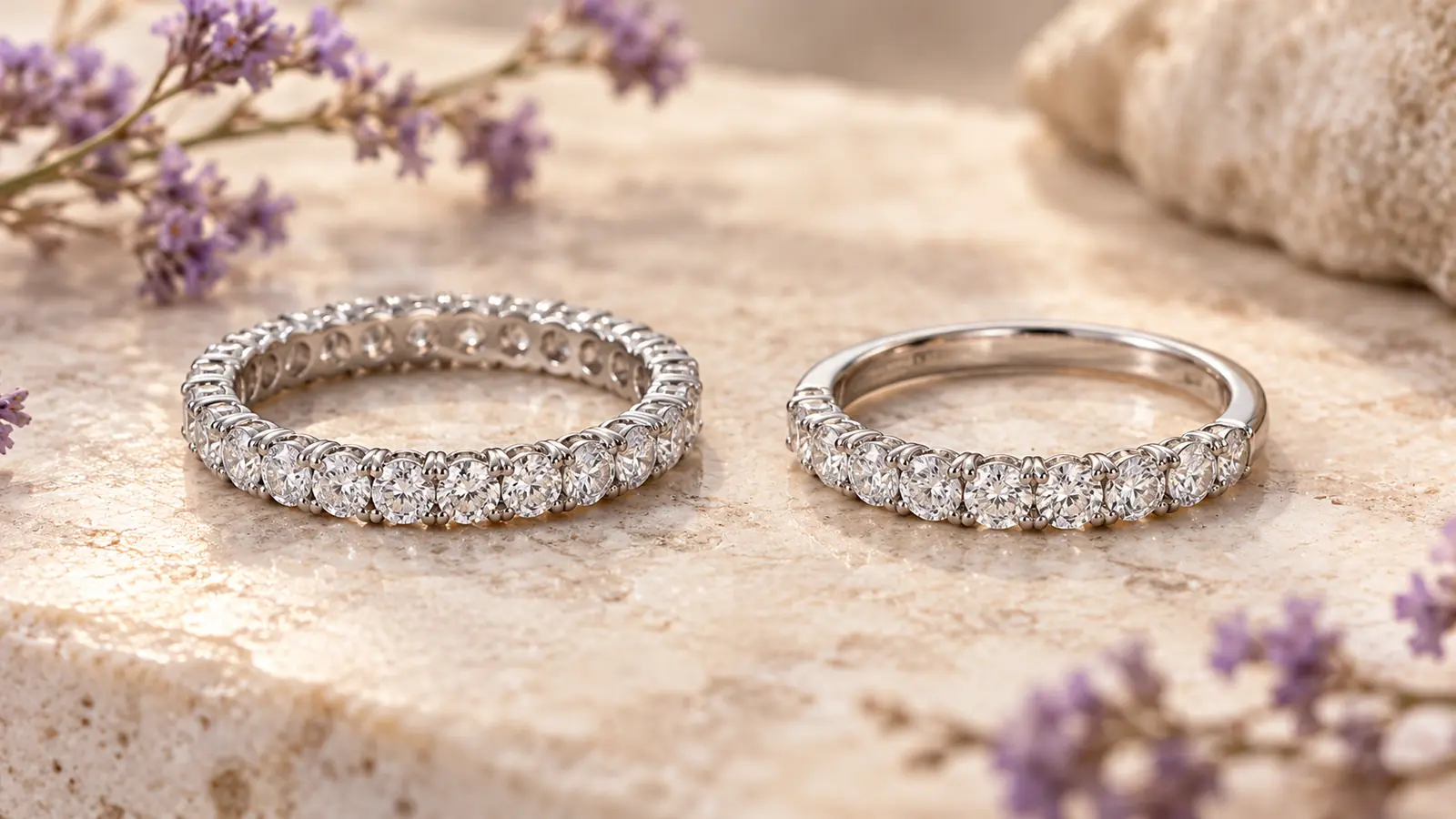
An eternity ring has to live alongside two other rings and still look like itself in twenty years. That makes it less a question of taste than of engineering: how far round the band the stones run, how firmly they are held, and what happens where metal rubs metal. Here are the decisions in the order they matter, including the awkward one at the end — finding her size without giving the surprise away.
Full, half or three-quarter
A full eternity ring carries stones the whole way round, with no plain section. A half eternity sets stones across the top half, the part that shows, and leaves the underside plain. A three-quarter eternity runs stones round everything except the section resting against the palm.
On a hand the visual difference is smaller than you would expect, because the lower third of any ring spends the day hidden. The practical difference is large, and it favours the half:
- It can be resized. A plain section gives a jeweller somewhere to cut and rejoin without disturbing a setting. A full eternity has no plain metal at all, so it usually cannot be altered — changing the size means remaking it.
- The stones are not where the damage is. The underside takes the worst of ordinary life: door handles, steering wheels, shopping bags, worktops. A half eternity puts smooth metal there instead of settings.
- It is kinder to its neighbours. A rounded plain underside sits against a wedding band without grinding at it.
- It is more comfortable against the next finger, where stones set low on the sides can be felt.
A full eternity is not a mistake: light all the way round, no right way up in the dark. Just treat the size as something that must be right first time.
Settings, and what gives way first
- Claw, or prong. Metal fingers grip each stone and lift it clear of the band. The most light and the most exposure; claw tips are thin by design and catch on knitwear.
- Grain, or pavé. Tiny stones held by minute raised beads of metal, reading as continuous glitter. Delicate, and the beads flatten gradually.
- Channel. Stones sit in a groove between two metal walls, roughly flush with the band. Snag-free and excellent for daily wear, but it traps soap and hand cream, and a loose stone is hard to spot early.
- Bar. A slim bar between each stone, edges left open — between channel and claw.
- Rub-over, or bezel. A collar of metal wrapped round each stone. The most protective and most forgiving of a knock; it shows the least light and suits softer stones better than anything else.
What fails is usually the metal, not the stone. Claw tips wear thin and bend outwards, grains flatten, and a channel wall can spread after a hard knock and lose its grip. The stones most at risk are the lowest on each side of a half eternity, where the setting meets the plain shank.
Two habits catch nearly everything. If the ring starts snagging on jumpers, something has lifted — have it looked at rather than pressing it back yourself. And hold the ring to your ear and tap it with a fingernail: a stone that has begun to move often gives a faint rattle.
Size, when the ring sits next to a wedding band
Start with the scale, because it is widely mis-stated. The British ring size scale is alphabetical, begins at A and continues past Z — Z+1, Z+2 and onwards — with half sizes between the letters. It is set out in a British Standard, and the arithmetic is simple: one letter step is about 1.25 mm of inside circumference, so a half size is a little over half a millimetre. Size C measures 40 mm round the inside, which lets you sanity-check any chart you meet. You will sometimes see the scale described as running from F to Z; that is a shop's stock range, not the scale.
Continental sizes are simply the inside circumference in millimetres.
| UK size | Inside circumference | Continental (EU) |
|---|---|---|
| F | about 43.8 mm | 44 |
| H | about 46.3 mm | 46 |
| J | about 48.8 mm | 49 |
| L | about 51.3 mm | 51 |
| N | about 53.8 mm | 54 |
| P | about 56.3 mm | 56 |
| R | about 58.8 mm | 59 |
| T | about 61.3 mm | 61 |
| V | about 63.8 mm | 64 |
| Z | about 68.8 mm | 69 |
American sizes are numeric, and published equivalents are approximate: UK L is usually US 5½ to 6, N 6¾ to 7, P 7½ to 8, R 8½ to 9, T 9¾ to 10, V 10¾ to 11. Charts disagree, so quote millimetres rather than a letter.
Now the eternity-ring specifics. Two rings on one finger behave like one wider band, and a wide band grips more of the finger, so it feels tighter than a narrow one of the same nominal size. If her engagement ring and wedding band are already snug together, adding a third is not a neutral act. Measure the finger it will actually be worn on — the dominant hand is often a touch larger. Match the profile too: a rounded inside edge, often called court or comfort fit, passes over a knuckle more easily than a flat one and sits better against a court wedding ring.
Metal: what wears, and what wears what
When two rings share a finger, the softer metal loses. A harder alloy will quietly cut a groove into a softer one over years of contact, so matching the metal already on the finger usually beats mixing for contrast.
- Platinum is dense and displaces rather than sheds metal when scratched, so marks burnish into a grey patina that polishes back.
- 18 carat gold is 750 parts gold per thousand: rich colour, a sound balance of hardness and workability.
- 9 carat gold is 375 parts per thousand. Harder at the surface but less forgiving, and paler.
- White gold is a gold alloy finished with rhodium plating. The plating is a wearing surface, so a daily ring wants replating from time to time to stay crisp — routine maintenance, not a fault.
- Silver is soft, and sterling is 925 parts per thousand. Lovely for a dress eternity ring; set permanently against a harder band on a hand that gets used, it takes the wear for both.
Mixing colours looks wonderful; just put the harder metal on the outside of the stack where you can.
Stones beyond diamond
Two properties matter: hardness, resistance to scratching, and toughness, resistance to chipping. The trade hardness scale runs to 10, where diamond sits. For a ring worn every day, 8 or above is the comfortable zone.
- Sapphire and ruby both sit at 9 and are the obvious coloured choices for daily wear. Sapphire comes in far more than blue — pinks, yellows, greens and near-colourless.
- Moissanite sits a little above sapphire and is a durable, very bright stone in its own right.
- Spinel at 8 is tough as well as hard, in beautiful reds, greys and blues.
- Topaz is also 8, part of why blue topaz has become such a popular eternity stone. It cleaves, though, so it is harder than it is tough and earns a protective setting.
- Aquamarine is just under 8 and acceptable, if more scratch-prone. Emerald is similar in hardness but usually full of inclusions, which makes it brittle — a dress-ring stone, and rubbed over if you set it in a band at all.
- Amethyst, citrine and the quartzes sit at 7: fine on a ring that comes off for washing up, hazy with fine scratches if worn continuously.
- Tanzanite, opal, turquoise and pearl are softer, more fragile, or both. Not for a ring that never comes off.
If she loves a softer stone, the answer is the setting and the habits: wrap it in metal, and take the ring off for anything abrasive.
If her size has changed
Fingers swell in warm weather, late in the day and on long flights, and shrink in the cold and first thing in the morning. Size also drifts genuinely over years, so her wedding size may not be the size to order now. Your options, in order of how little they disturb the piece:
- Sizing beads. Two small blobs of metal inside the shank take a loose ring down slightly and help it stay upright. Nothing is cut.
- A conventional resize, on a half or three-quarter eternity, within limits. Down is easier than up, and a stone-set shank can only be opened in the plain section.
- A new shank. If the underside of an older ring has worn thin anyway — and it eventually will — replacing it solves the wear and the size in one job.
- A different finger, or the other hand. Eternity rings move happily.
- Remaking, the only real route for a full eternity, and the moment to reuse the stones.
How to find her size without asking
- Borrow a ring she already wears on that finger. The only genuinely accurate method. Have a jeweller measure it on a mandrel, or measure the inside diameter across the widest point and work back from the figures above. Borrow one she wears regularly, not something from the back of a drawer, and note which finger it belongs on.
- Press a ring into something soft. If it cannot leave the house, press it edge-on into a bar of soap, modelling clay or adhesive putty for a clean impression, then measure that.
- Trace the inside. Lay the ring on paper, draw round the inner edge with a sharp pencil, measure the diameter. Less precise, far better than guessing.
- Use a sizing gauge. Plastic ring sizers and paper strips cost very little, and most jewellers will lend you one for checking the ring you have borrowed.
- Ask an accomplice. Her mother, sister or closest friend very often knows, and asking them is much less of a giveaway.
- Last resort: the common sizes. Jewellers will tell you most women's orders land around the middle of the alphabet, broadly L to N. Treat that as a starting point for a ring that can be altered, never as a basis for a full eternity.
Two rules whichever route you take. Check at the end of an ordinary day at normal room temperature, not on a cold morning. And remember the knuckle: the ring has to pass over it and then sit comfortably below it, so a prominent knuckle may need a size that feels slightly loose at the base. Mention that to the jeweller, because it changes which profiles will work.
Sources
- British Standards Institution, standard for ring sizes
- The Goldsmiths' Company Assay Office
- National Association of Jewellers
- Gemmological Association of Great Britain
- Gemological Institute of America, gemstone durability guidance