Jewellery for Older Hands: Fit, Clasps and Weight
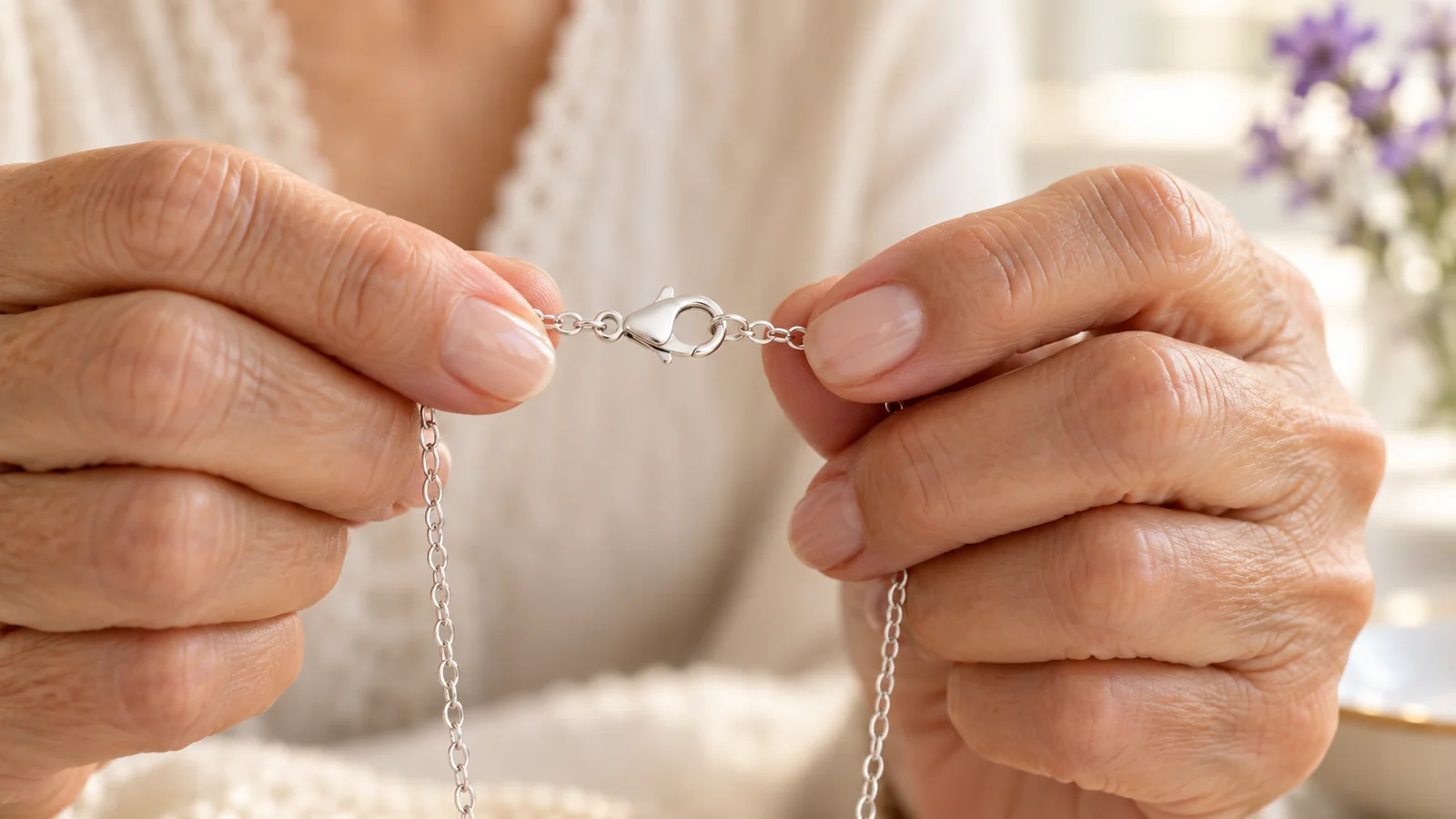
Choosing jewellery for a grandmother is rarely about taste. She usually knows exactly what she likes and has liked it for fifty years. The thing that goes wrong is practicality: a ring that will not pass the knuckle, a clasp that needs two steady hands and someone else's eyesight, a necklace heavy enough to be unwelcome by the afternoon. A gift that cannot be put on without help is a gift that stays in the box, politely. This guide is about the fitting and handling side of the choice — what makes a piece easy to wear every day, and what quietly makes it impossible.
One note before we start. Everything below is about the comfort and handling of the object, not about health. If there is any question about hands, that is a conversation for her and her GP, not for a jewellery guide.
Why a familiar ring size stops being the right one
Many older women have a size they have quoted confidently for decades, and are surprised when a ring in that size no longer goes on. Nothing has gone wrong with the measurement. What has usually changed is the relationship between the knuckle and the base of the finger: if the knuckle is now the widest point by a clear margin, a ring sized to sit snugly at the base simply will not travel over it, and a ring sized to clear the knuckle will then be loose and spin once it is on.
That gap is the single most common fitting problem on older hands, and it is a solvable one. The important thing is to stop treating the old number as the answer and measure both places:
- Wrap a strip of ordinary paper about five millimetres wide round the base of the finger, snug but not tight, and mark the overlap.
- Do the same round the widest part of the knuckle.
- Measure both marked lengths flat against a rule and keep both figures.
Avoid string, which tightens unevenly and reads small. If you can, take an existing ring that she wears comfortably to a jeweller instead and have it read on a tapered steel mandrel — a two-minute job that settles it. Hand both figures to the jeweller and let them tell you the size; the British lettered scale runs through the alphabet with half sizes in between, and translating a measurement into a letter is their job, not yours.
Two further points worth knowing. A wide band fits more tightly than a fine one of the same stated size, because it has more length of finger to clear, so allow roughly half a size more for anything broad. And hands measure a little fuller in warm weather and towards the end of the day, so a measurement taken once, on a cold morning, is not representative. Measure on a couple of different days and use the middle figure.
Rings that go over a larger knuckle
If the knuckle and base measurements differ noticeably, the jeweller's trade has several established answers. All of them let the ring pass over and then hold it still at the base.
- Sizing beads. Two small balls of metal fitted inside the band at the bottom. The ring is made to clear the knuckle, and the beads take up the slack at the base so it does not rotate. Unobtrusive, reversible and the usual first suggestion.
- A sizing bar or spring insert. A sprung strip set inside the shank that flexes open as the ring goes over the knuckle and closes to grip once it is in place. More positive than beads, and useful where the difference is larger.
- A hinged shank. The band is made in two parts with a small hinge and a catch, so it opens, goes on without passing over the knuckle at all, and closes. The most accommodating solution by some distance, and worth asking about where putting a ring on has become genuinely difficult. It needs to be made that way or converted by a jeweller rather than bought off the shelf.
- A ring guard or ring clip. A separate sprung clip that attaches to an existing ring, for when nobody wants the ring itself altered.
What to avoid: anything with stones set all the way round the band. A full eternity ring cannot be cut and resized, cannot take beads, and leaves you no options at all if the fit is wrong. A plain or part-set band keeps every door open.
Weight, and why it matters by the afternoon
A substantial piece is enjoyable for an hour and tiring for a day. Weight is the factor most often overlooked when buying for older hands, and it applies in three places.
Rings. A deep, heavy band is noticeable on the finger and makes the hand feel worked. A ring with a court-shaped inside — gently domed rather than flat — sits more comfortably and travels over a knuckle far more easily than one with a square inner edge. Ask for the inside profile, not just the outside look.
Earrings. Weight pulls at the lobe, and older piercings are often softer and more elongated than they were. Light studs and small hoops are kinder than long drops, and a stud with a flat, broad back rather than a tiny butterfly fitting is both more comfortable and much easier to handle. Hollow-made hoops look like solid ones and weigh a fraction as much.
Necklaces and bracelets. A heavy chain is felt at the back of the neck. Where a bold look is wanted, hollow or tube construction gives the visual presence without the mass. For bracelets, weight plus a rigid form is the least comfortable combination; a flexible chain distributes itself and a soft, light bangle is better than a heavy one.
Clasps that work with one hand
This is the detail that decides whether a necklace is worn or not. A clasp has to be operated behind the neck, out of sight, often with one hand doing most of the work. Ranked from easiest to hardest in practice:
- Magnetic clasps — the easiest of all, since the two halves find each other. Use them for light pieces; a strong magnetic clasp on a heavy chain can part under a snag, so a safety chain alongside is sensible.
- Large lobster clasps — a good compromise between security and handling, provided the lever is big enough to find by touch. The small ones defeat everybody.
- Screw-on or push-in barrel clasps — fine if the piece is short enough to fasten in front and turn round.
- Clasp extenders — a small sprung hook fitted onto an existing necklace, designed to make an awkward clasp manageable. Often the simplest fix for a necklace she already owns and no longer wears.
- Bolt rings and spring rings — common and among the hardest, because the little lever is small and stiff and has to be held open while the chain is hooked.
- Fine box clasps and safety catches — secure, fiddly, and best avoided unless there is always someone to help.
The same logic applies to bracelets, with an extra difficulty: a bracelet clasp has to be worked by the hand that is wearing it. A stretch bracelet on a strong elastic core, a slip-on bangle sized to pass the hand, or a cuff with an open back avoids the problem entirely and is usually the better gift.
Chain length, and putting a necklace on unaided
Length changes how a necklace is handled as much as how it looks. A very short chain sits at the throat and has to be fastened at the back, with the clasp pressed against the neck — the most awkward arrangement there is. A longer chain can be fastened in front and rotated round, which turns a two-person job into a one-person one, and a chain long enough to pass over the head needs no clasp work at all.
If you are buying a pendant, consider giving a slightly longer chain than looks obvious, or a chain with two or three fastening loops so the length can be chosen on the day. An extender chain added to a necklace she already likes is a small, thoughtful alteration.
What does not catch on clothing
Snagging is a daily irritation and a common reason a piece is quietly retired. The features that cause it are easy to spot once you know to look.
- Raised claw settings catch on knitwear and sleeves. Rub-over, or bezel, settings, where a rim of metal surrounds the stone, sit flush and snag far less — and hold stones more securely besides.
- Open filigree and pierced work looks lovely and collects wool fibres.
- Sharp shoulders and high profiles on rings catch when a hand goes into a pocket or a sleeve. Low, rounded designs do not.
- Fine, loose chain tangles with buttons and cardigan edges; a flat, close-woven chain is better behaved.
- Charm bracelets are charming and are the worst snaggers of all. Lovely for occasions, trying every day.
One more practical point: pieces that are easy to see are easy to use. A clasp with a contrasting finish, a slightly larger catch, a ring with a definite top so it is obvious which way round it goes — small things that remove a moment of fumbling each time.
Reworking something she already owns
Often the best gift is not a new piece at all. Most older women have jewellery they have stopped wearing, and the reason is usually mechanical rather than sentimental: the ring no longer goes on, the clasp broke, the chain snapped, an earring lost its partner. A jeweller can do a great deal with that.
- Resize a ring, or fit beads, a spring insert or a hinged shank so an old ring becomes wearable again.
- Replace a clasp with something she can manage, or add an extender.
- Repair or replace a chain, matching the original or choosing a sturdier gauge.
- Reset a stone from a ring that cannot be worn into a pendant, which needs no sizing at all and is the standard answer when a ring has become impossible.
- Remake a single surviving earring as a pendant or a brooch.
Giving a restored piece — her own mother's ring, wearable again — tends to land harder than anything bought new, and it sidesteps every sizing problem in this guide. Ask a jeweller for an opinion before assuming something is beyond help; a great deal is not. Allow time, as workshop turnaround lengthens considerably towards Christmas.
Sources
- The Goldsmiths' Company
- National Association of Jewellers
- British Standards Institution
- The Goldsmiths’ Centre
- Which?