Men's Rings Beyond the Wedding Band: Signet, Band and Fit
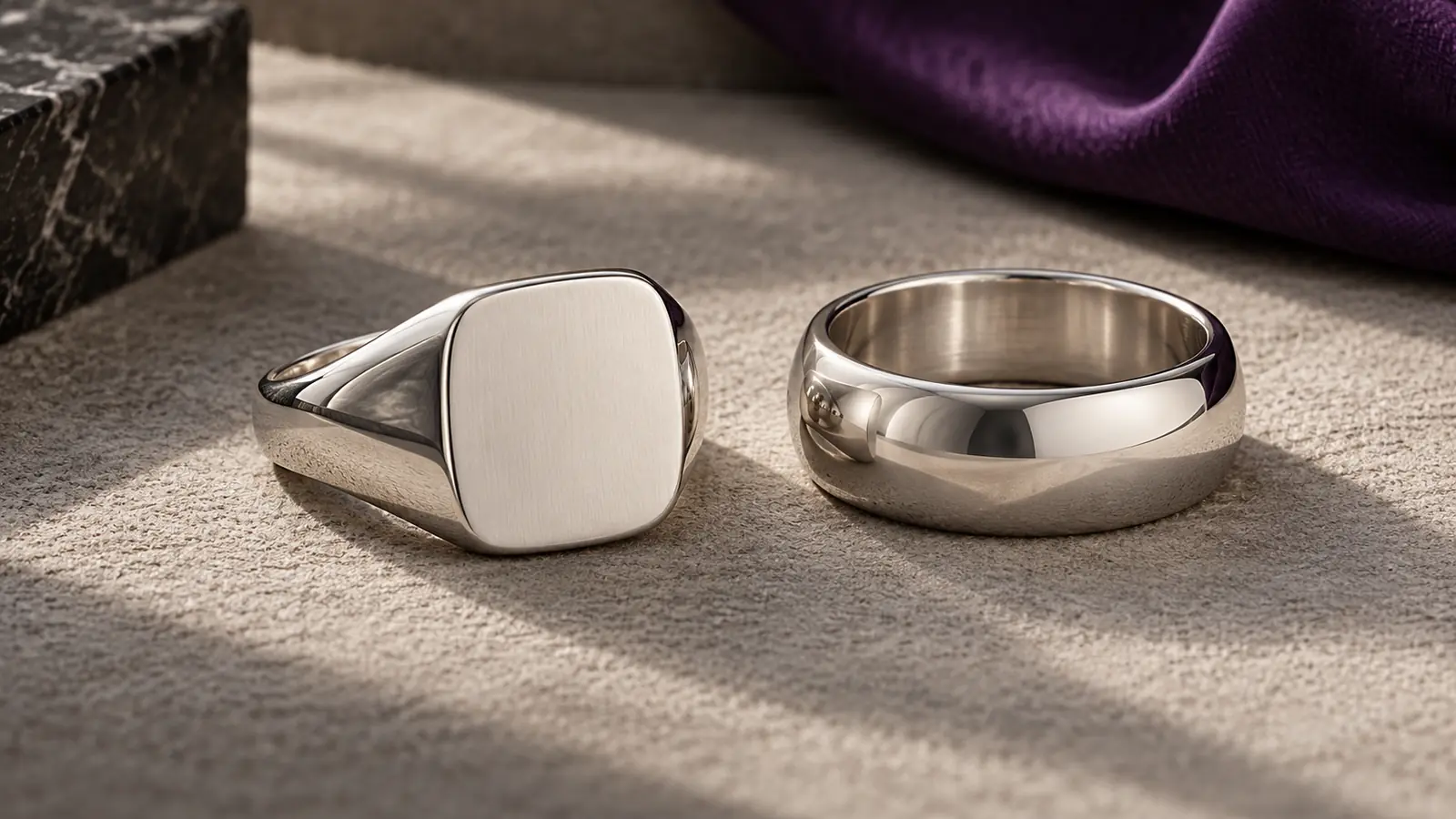
Most men own exactly one ring and have not thought about rings since the day they were handed it. That makes a second ring a genuinely good gift and a slightly risky one, because the things that decide whether he wears it — width, weight, profile, how it behaves at work — are invisible in a photograph. Here is what gets worn daily, what ends up in a drawer, and how to establish his size without tipping him off.
The types, and which ones get worn
- Signet ring. The classic second ring for a British man: a flat or slightly domed face on a tapered band, traditionally worn on the little finger of the left hand. The face can be plain, engraved with initials or a crest, or set with a flat stone — onyx, bloodstone and carnelian are the traditional seal stones. Low-profile, nothing to catch, and it carries meaning without shouting.
- Plain band. A second band on the other hand, or on the middle finger. Quiet and almost indestructible. The profile names are worth knowing: D-shape is rounded outside and flat inside, flat is flat on both faces, court is gently domed inside and out, and flat-court is flat outside with a rounded inside edge.
- Textured or hammered bands. A planished, brushed or hammered surface is the most forgiving finish there is: new scratches vanish into the texture instead of standing out across a mirror polish.
- Spinner and tag rings. A band with an outer ring that turns, or a flat engraved plate. Divisive — some men fiddle with them happily for years, others find them bulky.
- Stone-set rings. Fine if the stone is flat, hard and rubbed over in a collar of metal. A claw-set stone standing proud of the band will not survive a toolbag or a steering wheel.
The pattern across all of them: low profile gets worn, high profile gets put away. Anything that snags a pocket or digs into a palm under load will come off, and once a ring comes off it tends to stay off.
Width and weight: why a wide ring fits differently
This is the commonest sizing mistake, and it has nothing to do with measuring badly. A wide band fits tighter than a narrow band of the same nominal size. It covers more of the finger, grips more skin, and cannot flex over a knuckle the way a slim band does. Jewellers routinely advise going up around half a size once a band passes roughly 6 mm in width, and more for a really broad one.
A rounded inside edge offsets some of that. A court or comfort profile presents a curve to the finger rather than two square edges, so it passes the knuckle more easily and feels less like a clamp at the end of a hot day. On a wide ring it is close to essential.
Weight is the other half. A broad ring in a dense metal is noticeably heavy, which is either a pleasure or an irritation depending on the man. If he has never worn a ring on that finger, err narrower and lighter than you think: a 4 mm band is one he forgets he is wearing, an 8 mm one is a decision he makes every morning. And size him in the width he is actually getting — good jewellers keep sizers in several widths for exactly this reason.
His size, and how much it moves
The scale first, because it is often quoted wrongly. The British ring size scale is alphabetical. It starts at A and continues past Z — Z+1, Z+2 and onwards — with half sizes between the letters. It is defined in a British Standard: one letter step is about 1.25 mm of inside circumference, and size C measures 40 mm round the inside. If you see the range given as F to Z, that is a shop's stock, not the scale. Men's sizes sit mostly in the upper half of the alphabet, which is exactly where the scale carries on past Z — a large hand is not off the chart.
| UK size | Inside circumference | Continental (EU) |
|---|---|---|
| P | about 56.3 mm | 56 |
| R | about 58.8 mm | 59 |
| T | about 61.3 mm | 61 |
| V | about 63.8 mm | 64 |
| X | about 66.3 mm | 66 |
| Z | about 68.8 mm | 69 |
| Z+1 | about 70 mm | 70 |
| Z+2 | about 71.3 mm | 71 |
Now the moving target. Fingers are bigger in warm weather, bigger late in the day, bigger after exercise and after salty food, and smaller on a cold morning. Hands that do manual work swell more, and less predictably. For a man who works outdoors, January at seven in the morning and July at six in the evening can be most of a size apart.
So measure at the end of an ordinary day at normal room temperature, and on more than one day if you can. Then account for the knuckle: plenty of men have knuckles noticeably wider than the base of the finger, and a ring has to pass the knuckle and then not spin below it. Where that gap is large, the answers are a court profile, or sizing beads — two small blobs of metal added inside the shank that hold the ring upright without cutting it.
Metal, if his hands get used
- Platinum. Dense and tough. It displaces metal rather than losing it, so scratches burnish into a soft grey patina and polish back out. The heaviest option, which matters in a wide band.
- Palladium. White like platinum but much lighter on the finger, and a hallmarked precious metal in its own right. A good answer for a big hand that does not want the weight.
- 18 carat gold (750 parts per thousand) has the richest colour and is more ductile; 9 carat (375 parts) is harder at the surface but less forgiving. Either will deform under a real crushing load.
- Sterling silver (925 parts) is soft. On a working hand it will visibly record the year. For a signet worn socially that patina is part of the charm; for a ring that goes everywhere, it is a compromise to make knowingly.
- Tungsten carbide, titanium and ceramic resist scratching far better than any precious metal, but they generally cannot be resized at all, and a ring in a very hard material is much harder to cut off quickly in an emergency than gold, silver or platinum, which a jeweller can remove in moments. Worth weighing if he works with machinery.
Two practical notes. A brushed, matt or hammered finish still looks deliberate after years, while a high polish shows every mark within a week. And if his trade means rings come off at the gate anyway, buy a signet for off-duty rather than a band he cannot wear at work.
Engraving: what is actually legible
A signet face is a small canvas and the limit arrives sooner than people expect. In practice a monogram of two or three initials, or a single crest, is about what a face will carry and still read at arm's length. More than that becomes texture.
- Hand engraving cuts a V-shaped groove that catches light, holds fine detail on a curved surface, and can be re-cut if it wears. The traditional choice for a signet, and it looks it.
- Machine and laser engraving are shallower and more uniform — excellent for small neat lettering, weaker on depth and shadow.
- Seal engraving is cut in reverse, intaglio, so a wax impression reads the right way round. If he would ever actually use it as a seal, say so when ordering: a surface engraving that reads correctly on the ring comes out mirrored in wax.
- Inside the band is where a date, initials or a short line belong. A narrow band holds very little text, so count the characters with the jeweller rather than discovering the limit afterwards.
- Depth versus strength. Deep engraving into a thin section takes metal from somewhere it is needed; a jeweller will say if the design wants a heavier blank.
One thing to know before ordering: personalised goods are generally excluded from the right to cancel a distance purchase, so an engraved ring in the wrong size becomes a repair rather than a return. Settle the size first, engrave second.
Alloys, plating and comfort
Men's rings are usually substantial, which helps: in the United Kingdom silver articles of 7.78 g or more must be hallmarked, and most men's signets and bands are comfortably over that. So you should be able to see a proper set of marks — a sponsor's mark, the fineness number and an assay office mark — not just a stamped number.
Be wary of the vocabulary at the cheap end. Nickel silver, German silver and alpaca contain no silver at all; the names describe a colour. Silver plated and silver tone are not silver either, and plating wears through faster on a ring than on anything else, because a finger is in constant contact with everything. A plated band becomes a two-tone band within a year of real use.
If particular metals have been uncomfortable for him before, stick to hallmarked precious metals and ask specifically about the solder and any plating, not only about the body of the ring. UK law limits nickel release from items in prolonged contact with skin, which is a good reason to buy from a seller who can answer that question rather than an unmarked listing that cannot.
Getting his size for a surprise
- Borrow a ring he wears on the target finger. Have a jeweller measure it on a mandrel, or measure the inside diameter across the widest point. Note which finger and which hand.
- Do not simply copy his wedding band. Different finger, different hand, usually a different width and very often a different size. A sanity check, not a specification.
- Take an impression. If a ring cannot leave the house, press it edge-on into soap, modelling clay or adhesive putty and measure the mark. Tracing the inside on paper with a sharp pencil works at a pinch.
- Buy a sizer and make a game of it. Plastic ring sizers cost very little, and producing one at a family gathering and sizing everybody is a surprisingly effective cover.
- Recruit someone. A brother, a best friend or whoever was involved in the wedding ring often knows, or can find out without suspicion.
- If you truly cannot find out, choose a resizable precious metal rather than an unresizable hard material and plan on an adjustment. Jewellers will tell you most men's orders land broadly in the R to V region — a fallback starting point, not a fact about him.
Whatever you do, do not size a surprise ring at the limit of what will pass the knuckle. A ring slightly loose can be taken in or beaded; a ring that will not go on is a disappointment opened in front of everybody.
Sources
- British Standards Institution, standard for ring sizes
- The Goldsmiths' Company Assay Office
- The Assay Office Birmingham
- National Association of Jewellers
- Hallmarking Act 1973
- Consumer Contracts Regulations, cancellation of distance purchases