UK Ring Sizes Explained: How to Measure at Home Without Guessing
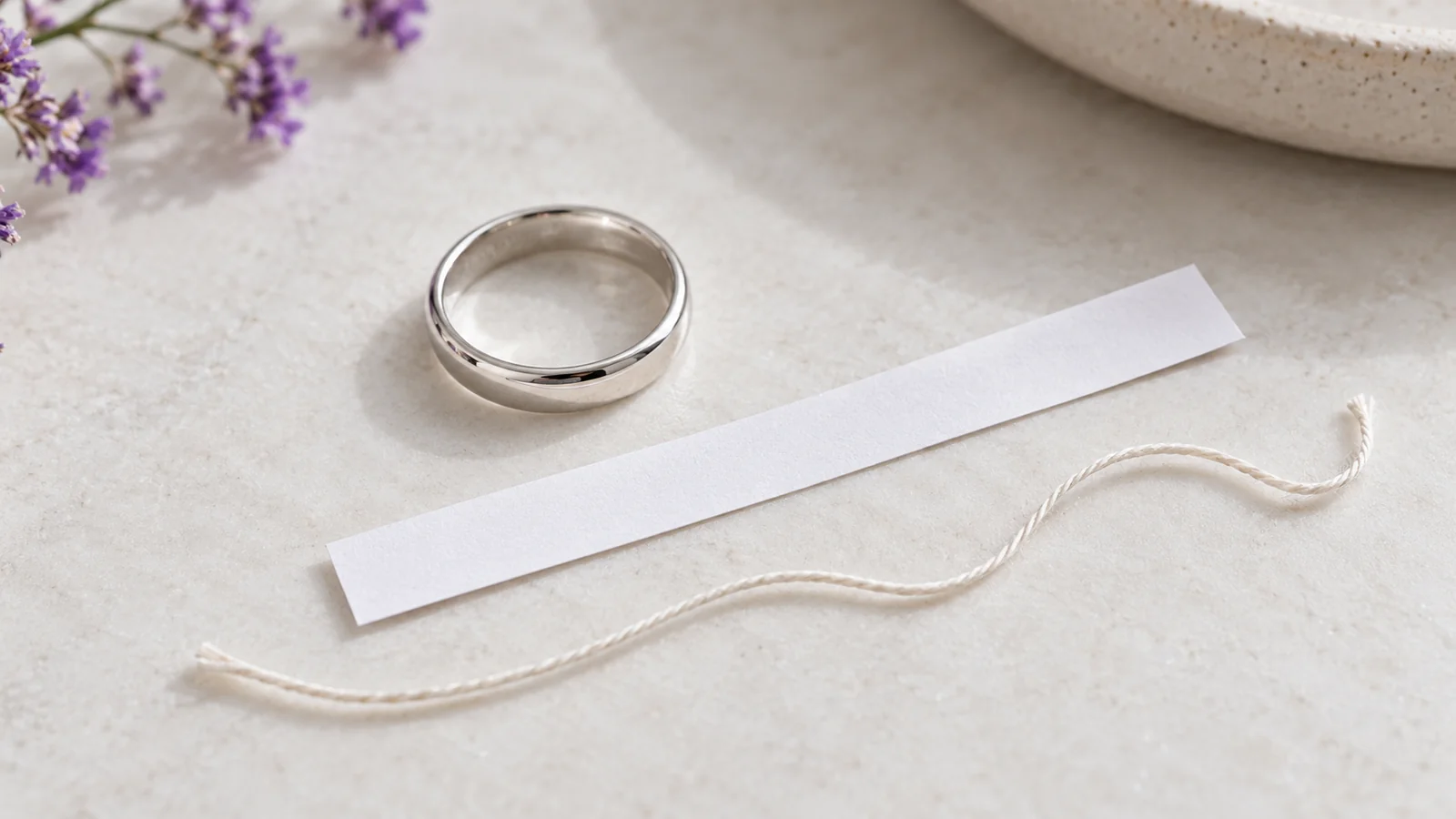
Ring sizing is the one part of buying jewellery where a confident guess is usually a wrong guess. The British system is lettered rather than numbered, fingers change size through the day and through the year, and the same stated size feels different on two rings of different widths. None of it is complicated, and all of it can be settled at a kitchen table with a strip of paper and ten quiet minutes. Here is the scale, the measuring methods that work, the ones that mislead, and what your options are if the ring still turns out wrong.
How the British lettered scale works
In the United Kingdom and Ireland, ring sizes are expressed as letters of the alphabet. The scale begins at A and continues beyond Z, with the larger sizes written as Z+1, Z+2, Z+3 and so on depending on the jeweller's convention. Between each pair of letters there is a half size: L and a half sits between L and M, and for many people a half size is the difference between a ring that spins and a ring that sits.
First, the scale is far wider than any one shop's range. A jeweller who stocks, say, F through Z is describing their own stock, not the limits of British sizing. Measure yourself at D, or beyond Z, and you have not made a mistake — you have found a size fewer shops keep on the shelf, more often made to order. Do not let a stock list talk you out of your own measurement.
Second, the British letters are not American numbers or European sizes. The US system uses numbers with halves and quarters; much of continental Europe uses a figure based on inside circumference in millimetres. Conversion charts exist and every jeweller has one to hand, but they are not worth reconstructing from memory. Measure in the system you are buying in, and ask a jeweller to convert anything that arrives in another.
What a size really describes is the inside of the ring — its internal diameter, or equivalently its circumference. That is why every method below comes back to measuring either the finger itself or a ring that already fits.
Four ways to measure at home, most to least reliable
1. An existing ring that already fits
This is the most dependable home method, because you are measuring a finished object rather than soft tissue. Take a ring that fits the correct finger on the correct hand — hands differ, and most people are slightly larger on their dominant hand — and measure straight across the inside, from inner wall to inner wall, through the centre. A steel rule or a digital caliper gives you a usable figure; a flexible tape does not, because it will not sit flat across a small circle.
Measure three or four times and keep the figure that recurs. Better still, take the ring itself to a jeweller: it goes onto a tapered steel mandrel and the size is read directly, which removes your ruler from the equation altogether.
2. A printable sizer or a paper strip
Cut a strip of ordinary paper about five millimetres wide and long enough to go round comfortably. Avoid anything stretchy, and avoid string, which tightens unevenly and lies to you. Wrap the strip round the base of the finger, snug but not biting, then work it over the knuckle while it is still wrapped. That second step is the one people skip, and it is the whole point: a ring has to pass the knuckle before it can sit on the base.
Adjust until the strip slides over the knuckle with slight resistance and still does not spin at the base, then mark where the end overlaps and measure the marked length flat against a rule. That length is the circumference. Again, take the figure to a jeweller for conversion rather than guessing at a letter.
Many British jewellers publish a printable sizing sheet, with circles to lay a ring over or a strip to cut out. One caution: these are only accurate printed at exactly 100% scale with no page fitting, and most carry a reference line or ruler so you can check. If the check line measures wrong, the whole sheet is wrong.
3. A plastic or metal ring sizer
A set of sizing bands, or a ribbon-style adjustable sizer, gives you the sensation of a real ring passing a knuckle, which no paper strip quite does. Metal sets read truer than plastic ones, which flex and can come out a half size small.
4. Being measured by a jeweller
Not a home method, but the benchmark the others are approximating. It takes two minutes in most high street shops and settles the question. For anything important — an engagement ring, a milestone birthday, anything engraved — it is the step worth making time for.
Why your size changes, and when to measure
Fingers are not fixed. The same finger can read a half size apart at different moments of the same day, and the pattern is consistent enough to plan around:
- Temperature. Warmth makes fingers fuller, cold makes them slimmer. Measure with cold hands in January and the ring will feel tight in July.
- Time of day. Most people measure slightly larger in the evening than first thing.
- Salt and alcohol. A salty meal or a heavy night shows in the fingers the next day.
- Exercise and heat. Hands swell during and after effort, and in hot weather generally.
- Longer-term change. Weight change, pregnancy and age all shift the figure, which is why a size noted down a decade ago is a starting point, not an answer.
The practical rule: measure at the end of a normal day, at normal room temperature, with hands that are neither cold nor just out of the gym. If you can, measure on two or three separate days and use the middle figure. A ring you can wear comfortably in both February and August is one measured somewhere near the middle of its range, not at either extreme.
Band width changes the fit
Two rings of the same stated size will not feel the same if one is a fine band and the other is a broad one. A wide band sits tighter, because it covers more of the finger and has to clear the knuckle across a greater length. The conventional allowance among jewellers is to go up by about half a size for a noticeably wide band, and the wider it gets the more that matters.
Heavy, deep bands behave the same way. A court-shaped or comfort-fit inside, gently domed rather than flat, slides over a knuckle far more easily and is worth asking about for anything wide. If you measured with a slim sizer and are buying something substantial, say so when you order.
When the knuckle is larger than the base
Plenty of people have a knuckle noticeably wider than the base of the finger, which leaves awkward arithmetic: a ring sized to pass the knuckle is then loose at the base. This is ordinary, and a jeweller has several established fixes:
- Sizing beads — two small balls of metal inside the band at the bottom, which stop the ring rotating while still letting it over the knuckle.
- A sizing bar or spring insert — a sprung strip inside the shank that flexes as the ring goes on and grips once in place.
- A fitted ring guard — a separate clip, for when you would rather not alter the ring itself.
- Hinged or open shanks — made that way rather than retro-fitted, and worth asking about for a ring that must go on and off easily.
Finding someone else's size without asking
If the ring is a surprise you have several good options and one bad one, which is guessing from the look of a hand.
- Borrow a ring she already wears, note which finger and hand it belongs on, and have a jeweller read it on a mandrel. Return it the same day.
- Draw round the inside if you cannot take it out of the house: stand it on paper and mark the inner circle carefully with a sharp pencil, or lay it over a printed sizing sheet.
- Ask a trusted third party. A sister, a best friend or a parent often produces the answer at once, and asking them is quieter than asking her.
- Enlist her indirectly. Trying rings on together at some unrelated moment is an old trick, and it works.
- Fall back to a typical middle size only as a last resort. Any jeweller will tell you the averages they quote for women's and men's ring fingers, but that is a placeholder chosen because it is easy to alter, not a measurement.
For a surprise ring in particular, choose a plain, round, reasonably even band if you can, because that is the shape most readily altered afterwards. A ring you expect to resize should be bought with resizing in mind.
If it does not fit
Most rings can be altered, but not all, and the design matters more than the metal. A plain band in silver, gold or platinum is straightforward work for a jeweller. What resists alteration:
- Stones set all the way round, as on a full eternity band — nowhere to cut, so these are remade rather than resized.
- Patterned, engraved or milgrain shanks, where cutting interrupts the design and the join shows.
- Tension settings, which rely on the spring of the metal to hold the stone.
- Titanium and tungsten, which generally cannot be sized conventionally and are exchanged instead.
- Thin, worn shanks, which may need rebuilding before they can be altered at all.
Ask about turnaround before committing, especially near Christmas and in the run-up to weddings. A simple sizing is often a matter of days; anything involving stones takes longer.
If the ring was bought at a distance — online, by phone or by post — you also have statutory cancellation rights under the UK's consumer contracts rules, which generally give you a short cooling-off period after delivery in which to change your mind, on top of any goodwill returns policy. One important exception: bespoke and personalised goods, including rings engraved to your instructions, are normally excluded from that right. Faulty goods are covered separately by consumer protection law however they were bought. Check the seller's terms, keep proof of posting, and if you are unsure where you stand, Citizens Advice publishes plain-English guidance.
Ring sizing rewards patience and punishes confidence. Spend the ten minutes, get the figure checked once by someone with a mandrel, and the ring arrives fitting — which is the entire point of it.
Sources
- The Goldsmiths' Company
- National Association of Jewellers
- British Standards Institution
- GOV.UK — accepting returns and giving refunds
- Citizens Advice