What Does 925 Actually Mean? How to Read a UK Silver Hallmark
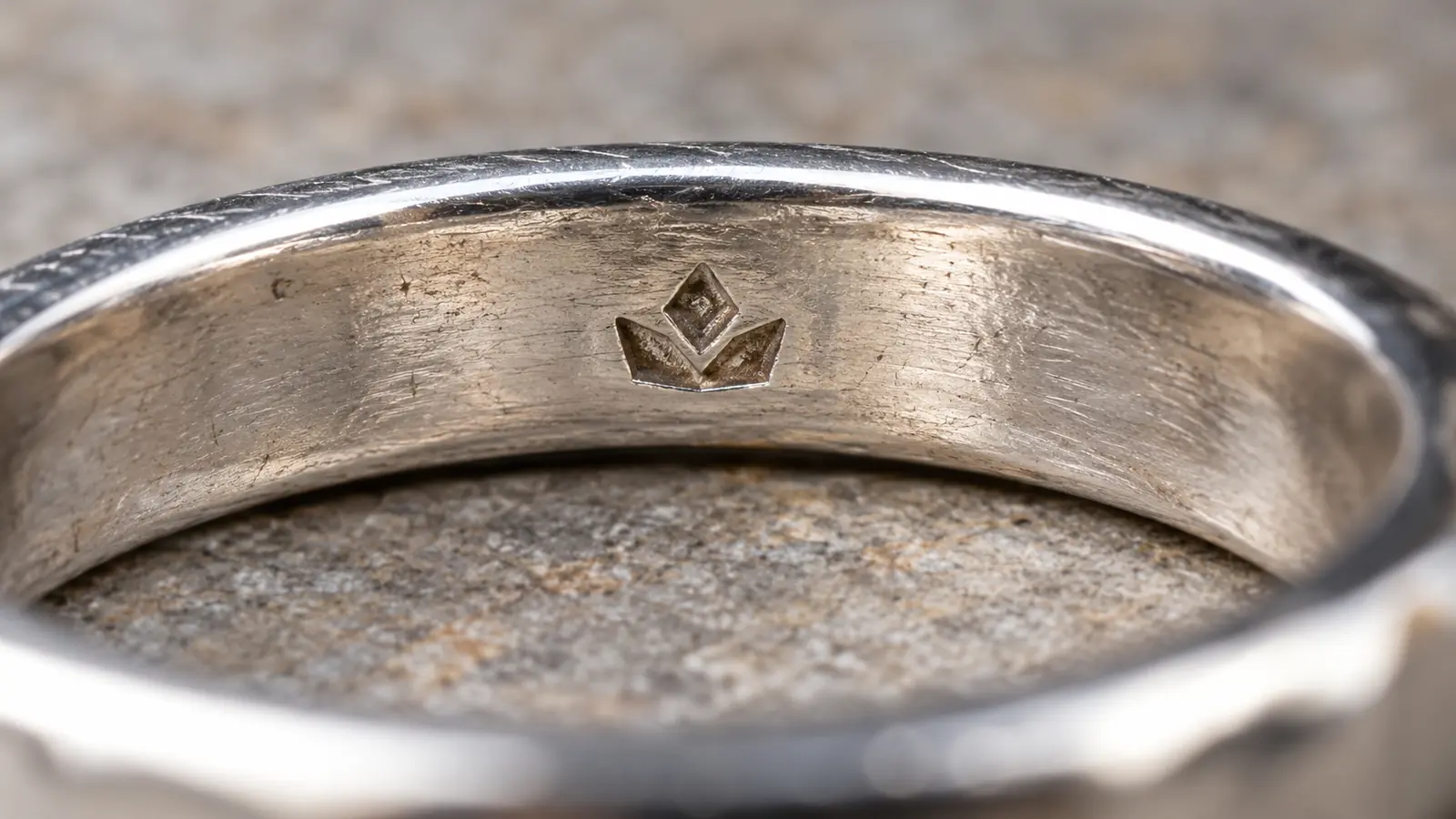
A tiny "925" stamped inside a ring is the most familiar mark in jewellery and one of the least understood. On its own it is a claim about metal content, nothing more, and in Britain a claim is not the same thing as a test. This guide explains what 925 means, what a complete British hallmark looks like, why a fine chain can quite legally carry no hallmark at all, and how to tell a properly marked piece from a hopeful one.
Sterling silver, and why not pure silver
Sterling silver is 925 parts silver per thousand, usually with copper making up the rest. Fine silver, at 999, is too soft for most jewellery: rings deform, settings loosen, chains stretch, and a bangle slowly loses its shape. Adding a small amount of copper gives silver enough hardness to hold a polish, hold a stone and survive being worn.
The number you see is a millesimal fineness: parts per thousand. The silver standards recognised in the United Kingdom are 800, 925, 958 and 999. The 958 standard is Britannia silver, a higher and softer standard than sterling that you will occasionally meet on quality silverware and contemporary pieces. In practice almost all silver jewellery sold here is 925.
The anatomy of a British hallmark
A full UK hallmark is not one stamp. It is a group of marks, struck after the article has been tested by an independent assay office, and three of them are compulsory:
- The sponsor's mark, sometimes called the maker's mark. Usually initials in a shaped shield, registered to the company or individual who submitted the article. It identifies who is responsible for it, not necessarily who made it by hand.
- The fineness mark, the millesimal number in a shaped surround — 925 for sterling. The shape of the surround itself carries meaning in the scheme.
- The assay office mark, showing which office tested and struck the article.
Alongside those you may find optional marks. The date letter, a letter in a shield denoting the year, has been voluntary rather than compulsory since 1999, which is why plenty of genuine modern silver has no date letter. The traditional fineness symbol is also optional now: the lion passant, a walking lion in profile, is the old symbol for sterling, and a seated figure of Britannia denotes the 958 standard. Their presence is a nice touch and a help with dating, but their absence proves nothing.
The four UK assay offices and their marks
Four assay offices currently operate in the United Kingdom, and each has its own town mark:
- London — a leopard's head.
- Birmingham — an anchor.
- Sheffield — a rose. Older Sheffield silver carries a crown instead; the rose came later.
- Edinburgh — a castle.
Those four symbols are the quickest way to confirm that a piece passed through a UK office. You may also meet the Common Control Mark, a balance-scales symbol used under the international convention on hallmarking to which the United Kingdom is a signatory. Marks applied under that convention are recognised here, so such a mark is legitimate: it simply means the testing happened outside the four British offices. The British Hallmarking Council, which oversees the system, has pressed for buyers to be able to distinguish marks struck at a UK office from recognised marks struck abroad, and its position on that has developed since around 2018. The practical point for you is unchanged: look at which office's mark is there, rather than assuming any mark implies British testing.
Where the marks hide
You will usually need a loupe, ideally ten times magnification, and good light. Look:
- Rings — inside the shank, often at the back opposite the setting.
- Chains and bracelets — on the clasp, on a small flat tag soldered beside the clasp, or on an end link.
- Pendants — on the back, on the bale, or on the edge.
- Earrings — on the post, the hook or the butterfly, where there is often simply not room.
- Bangles and cuffs — on the inside surface near a hinge or terminal.
Marks are often laser-struck rather than punched, so they can be faint and easy to miss; a zoomed phone macro photo sometimes reads better than a loupe.
The weight threshold, and why a thin chain may have no mark
This is the part that causes most unnecessary alarm. Compulsory hallmarking in the UK applies to silver articles from 7.78 g upwards. Below that weight an article is exempt, which is why a fine chain, a pair of small studs, a slim stacking ring or a delicate charm can be entirely genuine sterling silver and carry no hallmark at all. A slim band in a small size can weigh well under the threshold — the British ring size scale runs from A upwards and continues past Z, with half sizes between, and the lighter end of that range simply does not reach 7.78 g in a narrow profile.
So "no hallmark" on a light piece is normal. "No hallmark" on a chunky silver bangle offered for sale as silver is a question worth asking.
The legal weight behind all this is the Hallmarking Act 1973. Under it, it is a criminal offence to describe or supply an unhallmarked article as silver in the course of a trade or business, where that article is not exempt. That duty sits on the trader, not on a private individual selling an inherited piece, which is a useful distinction when you are buying second-hand from a person rather than a shop. UK retailers selling hallmarked precious metal are also required to display the statutory dealer's notice explaining fineness and hallmarks — the small framed card you see near the till in a jeweller's. Its absence in a shop is a reasonable thing to notice.
Checks you can do, and what each one is worth
No home test is conclusive. Used together, these will tell you whether to walk away or ask more questions.
- Magnet. Silver is not attracted to a magnet, so a strong pull is a bad sign. But plenty of imitations are non-magnetic too, and genuine jewellery contains steel springs and pins in clasps and earring fittings, so a slight tug at the clasp is normal. This test rules things out, never in.
- Weight and feel. Sterling silver is dense, roughly 10.3 to 10.5 g per cubic centimetre, noticeably heavier than brass, nickel alloys or steel of the same size. A piece that looks substantial and feels light is worth questioning.
- How it tarnishes. Silver tarnishes brown then black. It does not go green. Green residue on skin or metal points to a copper-heavy base alloy or to plating that has worn through — although even genuine sterling can occasionally mark skin, since there is copper in the alloy.
- Thermal behaviour. Silver is an excellent conductor, so it feels cold at first touch and warms fast. A hint, not evidence.
- Sound. The classic ring test works on coins and flatware, not on a chain or a set ring. Ignore it for jewellery.
- Professional testing. A jeweller or an assay office can test non-destructively with X-ray fluorescence. Acid testing kits exist but mark the piece, so they are not for anything you care about. If it matters, pay for a proper test rather than experimenting.
Trade descriptions that mislead
Most disappointment comes from wording rather than from forgery. Learn these:
- Sterling silver — solid 925 throughout.
- Silver plated — a microscopically thin silver layer over a base metal. Will wear through. Worth very little as metal.
- Sterling silver plated — still plated. The word "sterling" here describes the coating, not the piece.
- Silver filled — a thicker bonded layer than plate, but still not solid.
- Nickel silver, German silver, Alpaca or Alpacca — copper-nickel-zinc alloys containing no silver whatsoever. The name describes the colour.
- Tibetan or Nepalese silver — unregulated terms covering a wide range of alloys, frequently with little or no silver content.
- Silver tone, silver colour, silver finish — not silver.
- Vermeil — gold over sterling silver. In the UK the hallmark relates to the silver underneath, so you cannot read the thickness of the gold layer from the mark; ask the seller.
- "Tarnish-free silver" — overstated. Rhodium plating and germanium-bearing alloys genuinely slow tarnishing, but no solid silver is immune to it.
One more thing to check if your skin reacts to jewellery: sterling itself is not a nickel alloy, but nickel can be present in solders, in plating layers and in earring posts. If that matters to you, ask specifically about the posts and the plating rather than about the body of the piece.
If it turns out not to be silver
Buying from a UK trader gives you solid ground. Under the Consumer Rights Act 2015 goods must be as described, of satisfactory quality and fit for purpose; if silver turns out not to be silver, that is a straightforward failure of description. You have a short-term right to reject within 30 days of receiving the item, and after that a route through repair or replacement to a price reduction or a final right to reject.
Buying online or at a distance adds a separate right to change your mind, with a 14-day cancellation window from delivery under the consumer contracts regulations, although bespoke and personalised items such as engraved pieces are excluded from that right.
If a trader will not put it right, misleading descriptions of precious metal are a Trading Standards matter. The reporting route differs across the UK: in Great Britain complaints go in through the Citizens Advice consumer service, while in Northern Ireland they go through Consumerline. An assay office can test a disputed item and provide an independent result, which turns an argument into a fact.
A short checklist before you buy
- Does the listing say sterling silver or 925, rather than plated, tone or nickel silver?
- If the piece is substantial, can the seller show you three marks, not just the number?
- Which assay office mark is present?
- If there is no mark, is the piece genuinely light enough to be exempt?
- Does a shop display the dealer's notice?
- Is the stated weight in the listing, so you can judge the exemption for yourself?
- Are the earring posts and any plating described, if you are sensitive to nickel?
Read the marks, read the words, and weigh the piece in your hand. Between them those three habits catch almost everything.
Sources
- The Assay Office Birmingham
- British Hallmarking Council
- The Goldsmiths' Company Assay Office
- Hallmarking Act 1973
- Consumer Rights Act 2015
- National Association of Jewellers
- Citizens Advice and Consumerline (Northern Ireland)