What to Get Your Dad: Jewellery That Men Actually Wear
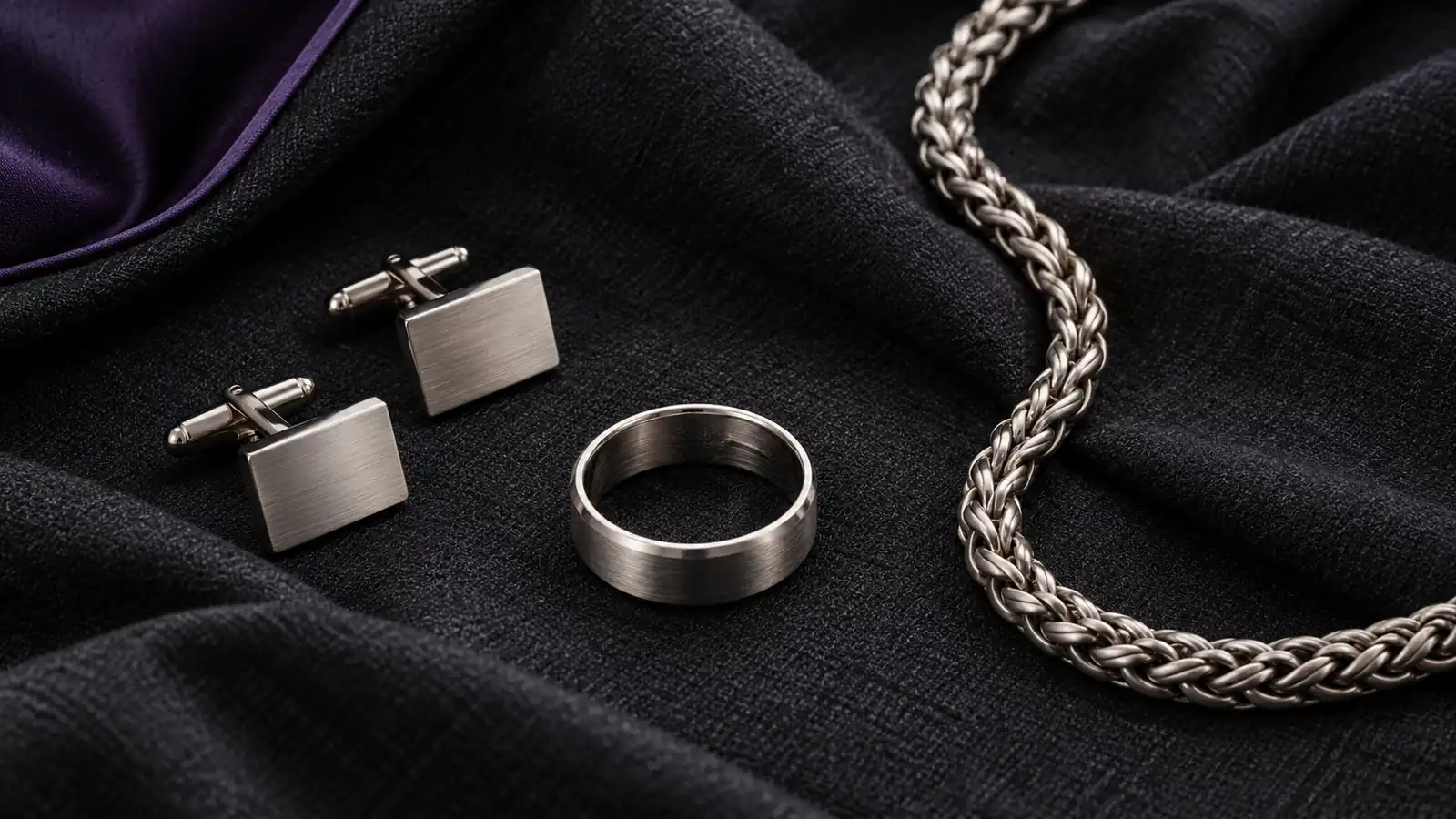
Buying jewellery for a man has a particular failure mode: the gift is appreciated warmly, worn twice, then lives in a box on the wardrobe shelf for a decade. It rarely fails because the piece was wrong. It fails because it never joined the three or four things he puts on without thinking. This guide covers what survives that test, how to get a ring size or a wrist measurement without asking, and what to give the man who wears nothing.
What gets worn every day, and what ends up in the box
Audit him rather than the shop. Most men wear a very short list automatically — often a watch, sometimes a wedding ring, sometimes a chain nobody sees under a shirt — and own a much longer one. The gift you want joins the short list. Three questions sort almost everything:
- Does it require a decision each morning? Anything he has to choose to wear eventually will not get chosen. Anything he forgets he is wearing stays on for years.
- Does it survive what his hands do? Anything that catches a pocket, digs into a palm under load, or has a stone standing proud of the metal comes off during the first real job — and then tends to stay off.
- Does it sit alongside what he already wears? Metal colour and weight want to match the watch or band he already has, or the new piece reads as a costume.
The pattern fits in one line: low profile gets worn, high profile gets put away.
Ring, cufflinks, chain or bracelet, matched to how he lives
- A signet or a plain band works best for a man who already wears a ring, because the habit exists. A signet is the traditional British second ring — a flat or gently domed face on a tapered band, worn on the little finger — and it carries initials well. A plain band is quieter still. Width matters more than decoration: a narrow band is forgotten, a broad one is a daily decision.
- Cufflinks only if he owns double-cuff shirts. Check the wardrobe before the shop. This is the most frequently wasted men's jewellery gift there is, bought for men whose shirts have buttons on the cuffs.
- A chain is the most underrated option. Worn under a shirt it is invisible, so it never has to match anything and survives work. For a man who has never worn jewellery it is the lowest-commitment wearable there is. Add a plain disc if you want something to engrave.
- A bracelet lives or dies by its clasp. A heavier bracelet loads its fastening, and that is where it fails. A push-box clasp with a safety catch, or a lobster fitting on a soldered-closed ring, is worth asking for by name. Lighter and open styles are also easier to size.
- Something he carries rather than wears — a keyring, a money clip — sidesteps the problem entirely: in his pocket every day, and it asks nothing of his taste.
Size: his finger, and his wrist
The ring scale first, because it is often quoted wrongly. The British ring size scale is alphabetical. It starts at A and continues past Z — Z+1, Z+2 and onwards — with half sizes between the letters. It is set out in a British Standard. A range quoted as F to Z is a shop's stock range, not the scale. Men's sizes sit mostly in the upper half of the alphabet, which is exactly where the scale carries on past Z, so a large hand is not off the chart. Letters do not convert to American numbers by eye, so always state which scale a size is in.
- Borrow a ring he wears on the finger you are buying for and have a jeweller measure it on a mandrel. Note the hand as well as the finger.
- Do not copy the wedding band. Different hand, different finger, usually a different width and often a different size. A sanity check, not a specification.
- Take an impression in soap, clay or putty if the ring cannot leave the house, and have the mark measured.
- Ask whoever organised the wedding ring. A brother, a best man or his partner often knows, or can find out unnoticed.
- Allow for swelling. Fingers are bigger in warm weather, late in the day, after exercise and after salty food, and hands that do manual work swell more and less predictably. Measure in the evening at room temperature, on more than one day if you can.
- Allow for the knuckle and the width. Plenty of men have knuckles wider than the base of the finger, so the ring must pass the knuckle and then not spin. A rounded inside profile helps, and a jeweller can fit sizing beads inside the shank. Separately, a wide band fits tighter than a narrow band of the same nominal size, so have him sized in the width he is getting.
For a bracelet, measure snugly around the wrist just past the wrist bone with a strip of paper. Then ask the maker how much allowance they add on top for the fit you want, because that allowance genuinely differs between workshops and is not worth guessing from a chart. Two extras: a rigid bangle must pass the widest part of his hand, not his wrist, so measure the hand squeezed narrow as well; and a chain bracelet with an extender forgives a near miss that a fixed length will not.
For a chain, measure one he already wears, laid flat, end to end including the clasp — a measured number beats a description. With nothing to measure, remember that a chain meant to sit under a shirt wants to fall below the collar rather than at the throat.
Metal, when his hands get used
- Sterling silver is 925 parts per thousand and soft. On a working hand it visibly records the year in fine scratches. For a signet worn socially that patina is part of the appeal; for a ring that goes everywhere it is a compromise to make knowingly.
- 9 carat gold is 375 parts per thousand, harder at the surface but less forgiving; 18 carat is 750 parts, richer in colour and more ductile. Either deforms under a real crushing load.
- Platinum is dense and tough, and displaces metal rather than losing it, so marks burnish into a soft grey and polish out. Also the heaviest choice, which matters in a wide band.
- Palladium is white like platinum but much lighter, and hallmarked as a precious metal in its own right. A good answer for a big hand that does not want the weight.
- Very hard industrial materials resist scratching far better than any precious metal, but generally cannot be resized, and are much harder to remove in an emergency than gold, silver or platinum, which a jeweller can cut off in moments. Worth weighing if he works around machinery.
Plating needs its own warning. A gold layer over another metal wears wherever something rubs, and on a man's piece the shank of a ring and the clasp of a bracelet go first. For daily wear, solid metal is the less disappointing choice. Ask what sits underneath and how thick the layer is.
If particular metals have been uncomfortable for him before, stick to hallmarked precious metals and ask about the solder and any plating as well as the body of the piece. UK rules limit nickel release from items in prolonged contact with skin, which is a good reason to buy from a seller who can answer that question rather than an unmarked listing that cannot.
Engraving and dates
Engraving is how a plain men's piece becomes his, and the constraint is area. The inside of a band, the back of a disc, the inner face of a bangle: each takes fewer characters than you imagine, so initials and a single date read better than a phrase. Block capitals hold up far better than fine script on a surface that will take knocks.
Ask for a proof and check every spelling yourself, because the cut is permanent. Write dates so they cannot be read two ways, and have the jeweller confirm any Roman numerals before cutting. Note too that having an item personalised usually removes your right to cancel a distance purchase, since the cancellation rules exempt goods made to your specification. Allow time as well: engraving and resizing queue badly before Father's Day and Christmas, so give anything personalised three to four weeks.
Presentation, because men open gifts differently
A decent box signals that the piece is meant to be kept rather than tried, and a short note explaining what the engraving refers to does more work than the engraving itself, especially with a date that is obvious to you and not to him.
Include the fineness information and a gift receipt, so a resize is possible: that is the difference between a ring altered to fit and a ring worn once politely. And do not wrap a surprise ring so he has to try it on in front of an audience — if the size is a guess, say so as he opens it and tell him the resize is already arranged. Men are far more likely to claim something fits than to admit it does not.
If he genuinely wears nothing
This is the most common situation and the most solvable, once you stop trying to turn him into someone who wears jewellery.
- Go for something carried, not worn. A keyring or a money clip in a good metal is in his hand every day, engraves well, and makes no demand on his taste.
- If it must be worn, choose the invisible option. A plain chain under a shirt is the lowest-resistance entry point: nobody sees it, it matches nothing, and it never has to come off.
- Restore something that already means something. His father's signet resized to his finger, a broken clasp replaced, an inherited piece cleaned and made wearable. The strongest option here, and nothing new is bought.
- Make the choosing the gift. Take him to a jeweller, let him pick, get him measured on the spot. You lose the surprise and gain a piece he wears.
- Accept the honest answer. If he wears a watch and nothing else, a strap, a watch box or a service for the watch he owns is jewellery-adjacent and will not sit in a drawer. The test is not whether a piece impresses him on the day, but whether it is still on him in two years.
Sources
- British Standards Institution, standard for ring sizes
- The Goldsmiths' Company Assay Office
- The Assay Office Birmingham
- Edinburgh Assay Office
- National Association of Jewellers
- Hallmarking Act 1973
- Consumer Rights Act 2015
- Consumer Contracts (Information, Cancellation and Additional Charges) Regulations 2013