What to Get Your Mum: A Jewellery Buyer's Guide for Birthdays and Mother's Day
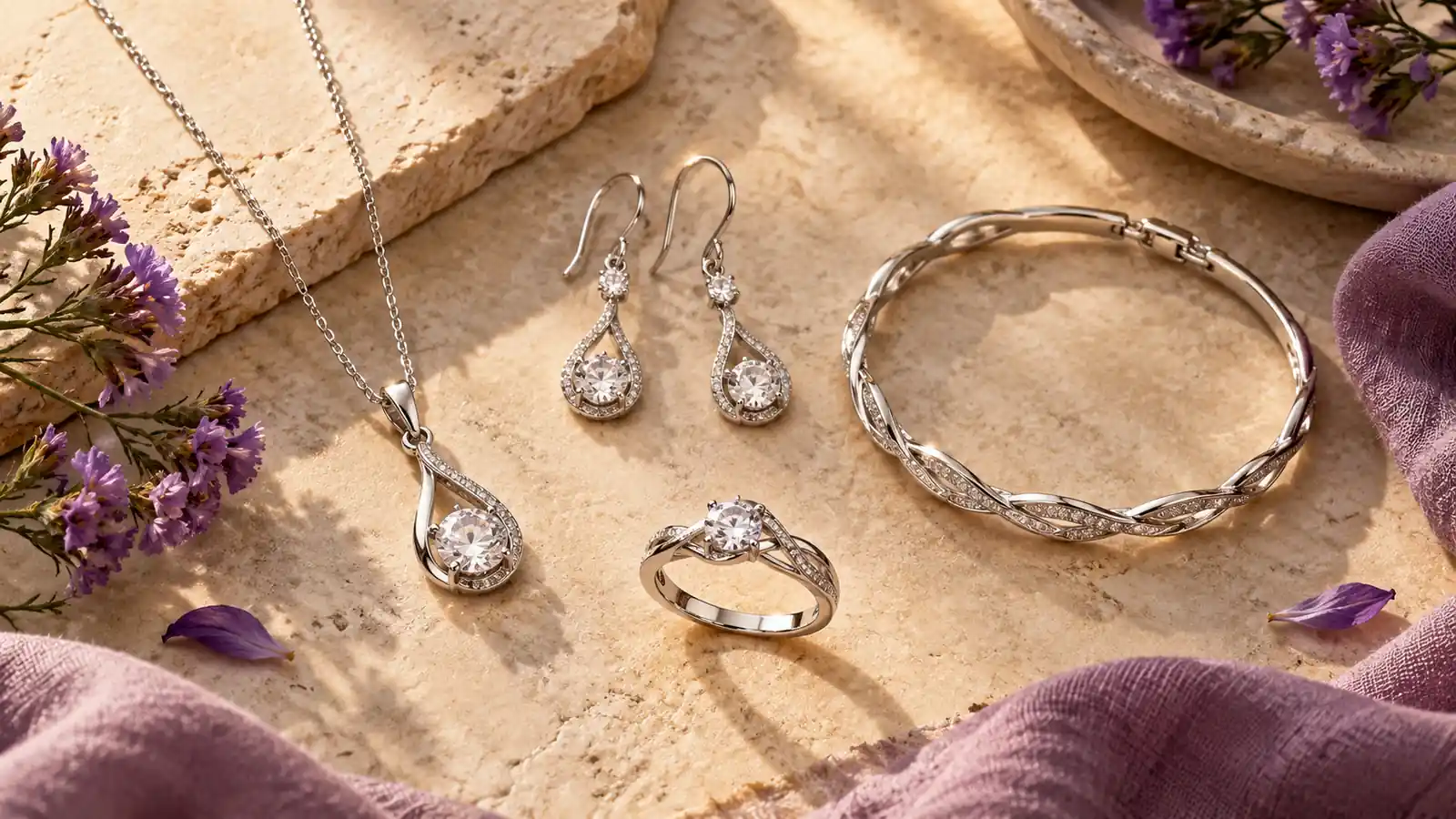
Jewellery is one of the few gifts still in use long after the day it was opened, which is exactly why it feels risky to choose. The worry is always the same: wrong size, wrong style, something polite that quietly goes into a drawer. This guide covers how to read what she already wears, which pieces need no measurement, how to establish a ring size without asking, and how far ahead to order.
Start with what she already wears, not with what you like
Almost every disappointing jewellery gift was chosen to someone else's taste. The fix costs nothing: spend one visit paying attention to her hands, ears, neck and wrists, looking for a pattern rather than an item. If she has worn the same slim yellow chain for fifteen years, a heavy silver collar is not a surprise, it is a mismatch.
The checklist you can run in a single afternoon
- Metal colour. Warm yellow, white, or the pinker tone of rose. Most people lean one way and stay there.
- Scale. Fine and barely-there, or deliberate and visible. Judge it by the width of her chains and the size of her earrings, not by how much she owns.
- Are her ears pierced, and what goes in them? The most useful item here, and the one most often assumed. Studs, small hoops and drops suit very different people, and fittings for unpierced ears exist but have to be asked for.
- Does she wear rings at all, and on which fingers? Someone who wears nothing on her hands is not a ring customer, however good the ring.
- Everyday or occasion. An everyday wearer wants something robust and quiet; an occasion wearer can take something far more decorative.
- What is broken or missing. A clasp she has to fight, a single earring whose partner is lost, a bracelet unworn since it got too tight. The best gift ideas in the house, and free to spot.
Ring, pendant, earrings or bracelet: which is safest without a size
If you cannot find out her size, choose by how much sizing the category demands. From safest to riskiest:
- Earrings need no size at all. Studs especially: nothing to measure, nothing to adjust, and they suit someone who wears very little as readily as someone who wears a lot. Confirm the piercing and the fitting she prefers.
- A pendant on a chain is nearly as safe. Chains come in a handful of commonly stocked lengths, most sellers will swap the length on request before dispatch, and a short extender solves a near miss afterwards. The reliable method is to measure her favourite chain flat, end to end including the clasp, and buy to that number rather than to a description.
- Bracelets sit in the middle. A chain bracelet with slack, or an open bangle you can ease on, forgives a lot. A rigid closed bangle forgives nothing, because it must pass the widest part of her hand rather than fit her wrist. Measure snugly around the wrist with a strip of paper, then ask the maker how much allowance they add on top — that differs between workshops and is not worth guessing from a chart.
- Rings are the hardest and the most personal, so they are worth the work. If you are short of time, buy the ring and arrange the resize instead of guessing wide and hoping.
How to find her ring size without asking
The scale first, because it is frequently quoted wrongly. The British ring size scale is alphabetical. It begins at A and continues past Z — Z+1, Z+2 and onwards — with half sizes between the letters. It is defined in a British Standard. If you see a range such as F to Z described as "the UK scale", that is a shop's stock range, not the scale itself. Letters do not convert to American numbers in any way you can do in your head, so whenever a size changes hands, say which scale it is in.
- Borrow a ring she wears on the finger you are buying for and have a jeweller measure it on a mandrel. Note which hand you took it from, because left and right usually differ.
- Take an impression if the ring cannot leave the house. Press it edge-on into soap, modelling clay or adhesive putty and have the mark measured.
- Buy a plastic ring sizer and make a game of it. They cost very little, and sizing everybody at a family gathering is an unreasonably effective cover story.
- Recruit an accomplice. A sister or a close friend often simply knows.
- Ask what is adjustable before you choose. A plain band can usually be taken up or down. A ring set with stones all the way round, or with a pattern running continuously, often cannot be resized without being remade.
Two things to allow for. Fingers are larger in warm weather and at the end of the day, and smaller on a cold morning, so work from an evening measurement at room temperature. And a knuckle wider than the base of the finger changes everything: the ring must pass the knuckle and then not spin below it. Where that gap is large, a rounded inside profile helps, and a jeweller can add sizing beads inside the shank. A wide band also fits more tightly than a narrow one of the same nominal size, so have her sized in the width she is getting.
Silver, gold plating, and what dulls first
Sterling silver is 925 parts of silver per thousand, and the tarnish it develops is a surface reaction with sulphur in the air rather than damage to the metal. It cleans off. What speeds it up decides where she should keep the piece: damp air, wool and felt, rubber bands, and household products containing sulphur. A soft dry cloth after wearing and a closed box or pouch keeps a piece bright for years.
Plating is where people get caught. Gold over silver or another base metal is a thin surface layer that wears wherever something rubs — so rings and bracelet clasps lose their plating long before earrings and pendants do. For a piece she will wear daily, either choose solid metal or accept replating as maintenance rather than a fault. Thickness varies enormously between makers, so ask what sits underneath and how thick the layer is.
On authenticity, the UK has a strong safeguard: precious metal above small weight thresholds must carry a hallmark struck by an assay office, showing the fineness in parts per thousand. Silver with no fineness mark is worth a question.
Engraving, and the lead time nobody plans for
Engraving turns a nice object into a specific one, and the constraint is area. The inside of a band, the back of a pendant, the inner face of a bangle: each takes fewer characters than you imagine, and block letters survive wear better than fine script.
Three warnings. Check every spelling yourself and ask for a proof, because there is no second attempt. Write dates in a form that cannot be read two ways, and be wary of Roman numerals. And understand that personalising an item usually removes your right to cancel the order — the cancellation rules for distance purchases exempt goods made to your specification.
Then allow time. Engraving, resizing and chain changes are workshop jobs that queue. A fortnight is comfortable for something ready-made; give anything engraved, resized or made to order three to four weeks, and ask for a committed date in writing.
Mother's Day in the UK moves every year
This catches people out constantly. Mothering Sunday in the UK is not fixed to a calendar date, and it is not the same day as Mother's Day in the United States. It falls on the fourth Sunday of Lent — three weeks before Easter Sunday — so it lands in March most years and in very early April occasionally. Because Easter moves, this date moves with it, sometimes by a fortnight from one year to the next.
So look the date up and diary it early rather than trusting last year's memory, and accept that the week before is the worst possible time to order anything needing a workshop. For engraving or a resize, your real deadline sits three or four weeks before the one on the calendar.
Returns, exchanges and the first resize
- Bought online, by phone or by post, you normally have a short window after the goods arrive in which you can cancel for no reason, then a further period to send them back. Personalised and made-to-measure items are excluded.
- Bought in a shop, there is no automatic right to change your mind. Any exchange is the shop's own goodwill policy, so ask what it is and get it written on the receipt.
- If something is faulty, that is separate and stronger: consumer law gives a short-term right to reject faulty goods, with further remedies after that.
- Pierced earrings are often excluded from returns on hygiene grounds once the packaging is opened. Check that before you settle on earrings as the safe option.
- Ask about the first resize. Many jewellers include one free resize within a set period on rings they have sold — the cheapest insurance against a guessed size, and usually only available if you ask. Keep the paperwork and give her a gift receipt, so she can have the piece adjusted instead of wearing it twice out of kindness.
If she says she does not wear jewellery
Sometimes that is true; sometimes it means she has never been given anything easy to wear. Either way, there are better moves than a larger version of what she already ignores.
- Repair or revive what she owns. A clasp she can work one-handed on a necklace she loves, a re-strung row of beads, a ring resized to the finger that fits now. These land hardest, because the observation comes attached.
- Choose the smallest possible version. One pair of plain studs, or one fine chain. A statement piece is a gift for someone who already wears jewellery.
- Buy nothing and go together. A trip to a jeweller where she chooses removes every guess at once, and the sizing gets done properly on the spot.
- Think about the obstacle rather than the object. If fiddly clasps are the problem, look at magnetic or push-box fittings. If weight is the problem, look at lighter construction. If she forgets, something she never takes off solves it.
Sources
- British Standards Institution, standard for ring sizes
- The Goldsmiths' Company Assay Office
- The Assay Office Birmingham
- Edinburgh Assay Office
- National Association of Jewellers
- Hallmarking Act 1973
- Consumer Rights Act 2015
- Consumer Contracts (Information, Cancellation and Additional Charges) Regulations 2013
- Church of England, Mothering Sunday in the Lenten calendar