Why Silver Tarnishes and How to Clean It Safely
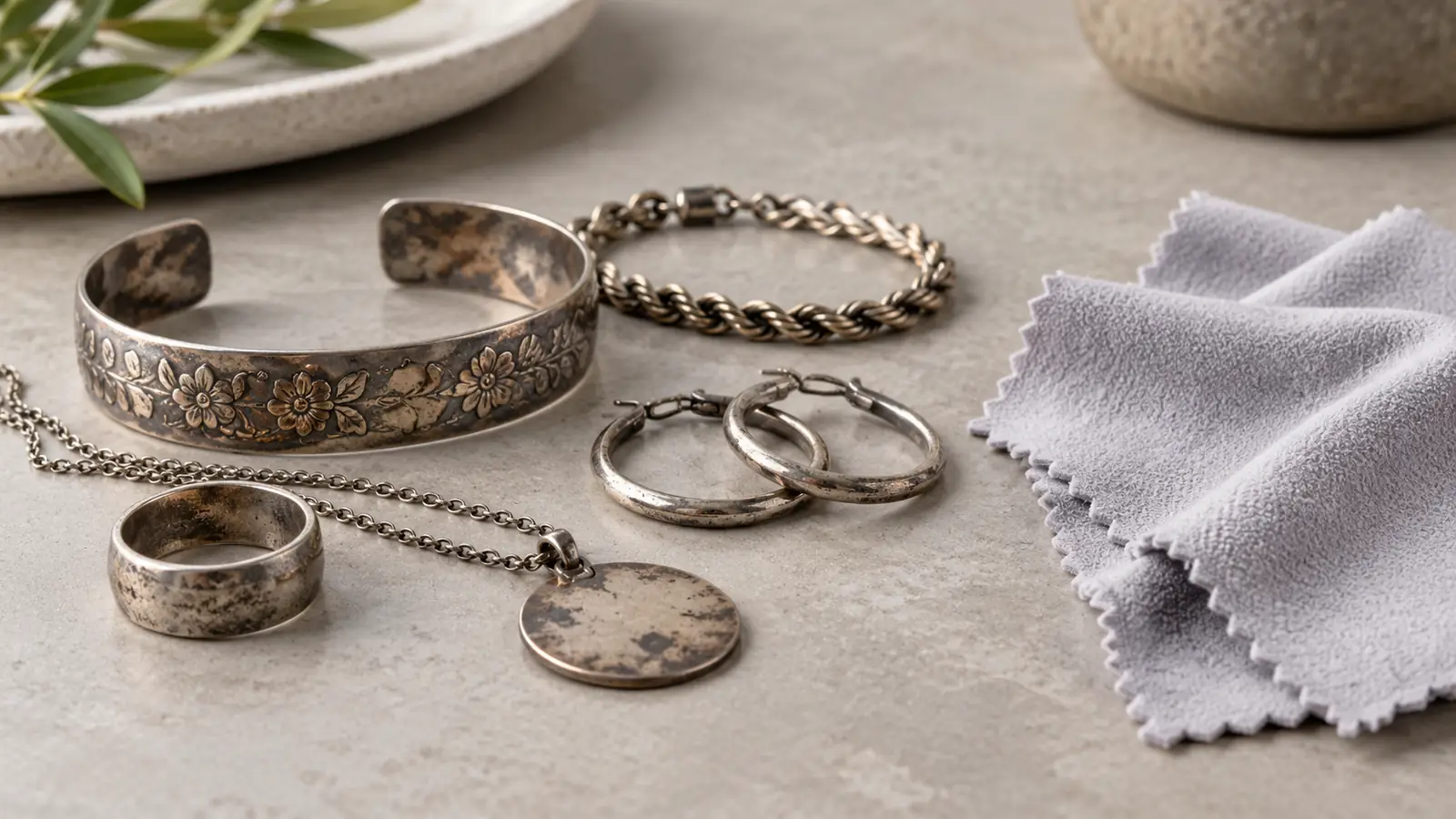
A silver chain that has gone dull or almost black has not turned out to be fake, and it is not dirty in any ordinary sense. It has reacted with sulphur in the air. Understanding that changes how you clean it: the goal is to remove a thin chemical layer without removing the metal underneath or the finish on top. Here is how to do that, which popular shortcuts quietly destroy jewellery, and how to slow the whole process down.
The chemistry, briefly
Tarnish on silver is silver sulphide, formed when the surface reacts with sulphur-bearing gases present in ordinary air. It builds as a film, going yellow, then brown, then blue-black. Because it is a reaction rather than a deposit, no amount of soap will shift established tarnish, and because it is a surface layer, the silver beneath is unharmed.
Several things speed it up:
- Humidity. Moisture accelerates the reaction considerably. Damp homes, coastal air and bathroom shelves are all bad news.
- Airborne sulphur from traffic, heating and industry.
- Rubber and some plastics. Rubber bands are notorious: they release sulphur compounds and leave a black band across a piece.
- Wool, felt, cardboard and newspaper. Wool and felt contain sulphur-bearing proteins; cardboard and newsprint are acidic. All are poor long-term storage.
- Food. Eggs, onions, mustard and mayonnaise are classic offenders.
- Cosmetics and toiletries. Perfume, hairspray, sunscreen, fake tan, hair dye and some moisturisers leave residues that dull or attack the surface.
- Chlorine and salt. Swimming pools and hot tubs are genuinely damaging to silver, and seawater leaves salt that keeps working after you dry off.
- Household chemicals. Bleach and chlorine-based cleaners will corrode silver, not just dull it.
- Sweat. Body chemistry varies, which is why two people wearing identical chains get different results.
Hard water, which affects large parts of the UK, is a separate issue often confused with tarnish. It does not cause sulphide films; it leaves limescale and soap residue that make silver look cloudy and grey. That dullness washes off. Tarnish does not.
Why your pieces tarnish at different rates
Three factors explain most of the variation. Plating: rhodium-plated silver stays bright far longer, since the surface is not bare silver. Alloy: germanium-bearing sterling alloys tarnish more slowly, and the copper in ordinary sterling contributes to darkening. Surface and construction: a high polish tarnishes visibly but cleans easily, while textured, engraved, matte and oxidised surfaces hold tarnish in their recesses, and a densely woven chain traps moisture between links where no cloth will ever reach.
Before you clean anything, identify the piece
This step saves jewellery. Ask:
- Are there stones? Which ones?
- Are they claw-set or glued? Flat-backed crystals, cabochons and pavé very often are.
- Is any part deliberately blackened — oxidised recesses, antiqued detail, niello?
- Is it plated — rhodium, or gold over silver (vermeil)?
- Is there enamel?
- Is it hollow, or are beads strung on thread or silk?
- Is it antique or irreplaceable?
A "yes" to any of those rules out most aggressive methods. Plain, solid, unset, unplated silver is the only category you can treat robustly.
Safe cleaning, step by step
1. Wash first. Warm, not hot, water with a very small amount of mild washing-up liquid. Plain solid silver can have a short soak; anything with stones, glue, enamel, strung beads or hollow construction should only be wiped with a damp cloth. Never use hot water on a piece with stones — thermal shock cracks some gems.
2. Lift residues gently. For grooves and chasing on plain silver, a very soft brush, softer than a toothbrush, moved lightly. Not on oxidised detail, not on plating.
3. Rinse and dry thoroughly. Rinse in clean water, then dry at once with a soft lint-free cloth and let the piece air-dry completely before storing. Trapped moisture is the single most effective tarnish accelerator, and hollow pieces need longer than you think.
4. Polish light tarnish with an impregnated silver cloth. Work in straight strokes rather than circles, with light pressure. Understand the trade-off: every polish removes a trace of metal and of any plating, so polish when it is needed rather than as a routine.
5. For heavier tarnish on plain, unset, solid silver, a proprietary silver cream or paste intended for jewellery, applied sparingly on a cotton pad, then rinsed and dried properly. Keep it well away from stones, glued joints and oxidised recesses.
6. Chains. Lay the chain flat and work a short section at a time; dragging a cloth along a fine chain kinks it, and kinks become breaks.
Silver dip: what it is and who should avoid it
Silver dip is the liquid you lower a piece into for a few seconds and watch the blackness vanish. It is typically an acidified solution containing thiourea, and it works by chemically dissolving the sulphide rather than rubbing it off. That is a real advantage in one respect: it reaches inside chain links and deep engraving where no cloth can go, and it removes tarnish without abrasion.
It also carries real risks, which is why conservation practice treats dips with caution on objects that matter:
- It attacks the surface, not just the tarnish. Overuse or long immersion leaves a flat, whitish, slightly etched look that a polish will not fully bring back.
- Residues keep reacting. Solution trapped in crevices, under settings and inside hollow pieces continues to work after you think you have finished, causing staining and corrosion later. Thorough rinsing is not optional, and on hollow or porous pieces it may not be achievable at all.
- It strips deliberate finishes. Oxidised and antiqued silver loses its contrast immediately, and the effect is not reversible at home.
- It damages many gems. Pearls, coral, amber, jet, turquoise, opal, lapis lazuli, malachite and fracture-filled emerald are all vulnerable to acidic solutions.
- It creeps under adhesive and weakens glued settings, and it can harm plating, marcasite and anything gilded or enamelled.
- It is a hazardous chemical. Ventilate, keep it off your skin, follow the label, and store it away from children.
Avoid silver dip entirely if your piece has stones of any kind, pearls, enamel, glued components, an oxidised or antiqued finish, plating or gilding, marcasite, hollow or filled construction, or any antique or sentimental value. If what you have is a plain, solid, unset silver chain or band and you follow the label and rinse obsessively, it is a legitimate tool. It should never be part of a weekly routine.
The methods that ruin jewellery
- Toothpaste. It contains abrasives. It will leave a fine haze of scratches across polished silver, dull a mirror finish permanently and wear straight through plating.
- Bicarbonate of soda paste. Also abrasive. It removes metal, strips plating and lifts oxidised detail out of recesses.
- Salt and vinegar, lemon juice, descaler. Uncontrolled acid etching, with no way to stop it at the right moment.
- The aluminium foil and hot soda bath. This converts the tarnish back chemically rather than abrading it, which sounds ideal, and the result is usually a dull, slightly porous grey surface rather than a bright one. Worse, a hot alkaline bath is bad news for glued settings, soft and porous stones, enamel, plating and soldered joints, and it can loosen stones.
- Ultrasonic cleaners. Not a home tool for silver jewellery. The vibration loosens stones in worn settings, can propagate existing fractures in included or treated stones, drives liquid into hollow pieces and under glued settings, and damages pearls, opal, emerald, turquoise and amber. If a piece genuinely needs one, that is a decision for a jeweller who has inspected the settings first.
- Bleach and chlorine cleaners. Corrosive to silver. Never.
- Scouring pads, erasers, car metal polish, polishing wheels and rotary tools. All remove metal faster than you can judge.
- Steam cleaners and dishwashers. Heat, harsh detergent and knocks.
Special cases
- Pearls. Wipe with a soft, barely damp cloth and nothing else. No soaking, no dip, no ultrasonic. Silk thread stretches and absorbs, so strands need restringing periodically.
- Porous and soft stones — opal, turquoise, amber, coral, jet, lapis, malachite, moonstone and most treated or dyed stones. Dry cloth only, or the very lightest damp wipe.
- Glued settings. Never submerge. Water alone will eventually break down the adhesive.
- Oxidised and antiqued silver. Mild soap and a soft cloth on the raised highlights only. A polishing cloth dragged across the dark recesses erases the design.
- Vermeil and gold-plated silver. The gold layer is only microns thick. Mild soap, soft cloth, pat dry. No polishing cloths, no creams, no dip.
- Rhodium-plated silver. The brightness is the plating, so do not polish it away. Wash and dry only.
- Enamel. Chips easily and dislikes temperature changes and soaking.
- Marcasite. Many tiny stones held with adhesive or cement. Keep it dry.
- Hollow beads, hollow bangles and lockets. Liquid gets in and stays in. Surface wipe only.
When it is a job for a jeweller
Take a piece in rather than persevering if a stone moves or rattles, if claws look worn or bent, if a chain has kinked or snapped, if a ring has gone oval or links have stretched, if deep scratches need repolishing, if an oxidised finish or worn rhodium plating needs restoring, or if pearls need restringing. Antique and inherited pieces are worth a professional opinion before any cleaning at all — a well-meaning polish can remove both value and history in one afternoon.
Prevention, which beats cleaning
- Last on, first off. Put jewellery on after perfume, hairspray, moisturiser and sunscreen have dried, and take it off before washing up, swimming, showering, the gym, gardening and bed.
- Wipe it after wearing. Ten seconds with a dry soft cloth removes sweat and cosmetics before they settle in.
- Store it airtight. One piece per small resealable polythene bag with the air pressed out, or a pouch sold as tarnish-resistant. Add an anti-tarnish strip, which absorbs sulphur, and a silica gel sachet if your home is damp, which absorbs moisture. They do different jobs, so in a damp house you may want both.
- Avoid the wrong containers. No rubber bands, no untreated wool or felt linings, no cardboard or newspaper, no oak drawers, and never the bathroom.
- After the sea, a pool or a sweaty session, rinse in fresh water and dry immediately. Better still, take it off beforehand.
- Wear your silver. Pieces in regular use, wiped afterwards, stay brighter than pieces shut away for a year.
The short version: wash gently, dry completely, polish sparingly, store airtight, and keep abrasives and dips away from anything with a stone, a glue joint or a finish you would miss.
Sources
- Victoria and Albert Museum
- The British Museum
- The Institute of Conservation (Icon)
- The National Trust Manual of Housekeeping
- The Goldsmiths' Company
- National Association of Jewellers
- Which?